Best Gluten-Free Magnesium in Pregnancy: BabyRx Wins

Five gluten-free magnesium picks compared on form, dose and pregnancy suitability, with a clear winner for expecting shoppers and one alternative for anyone who prefers a sipped powder at night.

By Harley GriffithsUpdated 12 min read
On this page
- Best gluten free magnesium for pregnant women at a glance
- Who should not use this shortlist as-is
- Which magnesium form actually matters here?
- 1. BabyRx Calm & Sleep Support — Best overall
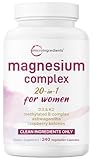
- 2. Micro Ingredients Magnesium Complex for Women — Best value
- 3. Nobi Nutrition Magnesium Glycinate 500mg — Best budget pick
- 4. Pink Stork Magnesium Glycinate with Vitamin D — Best simple daily
- 5. Perelel Sleep Support Magnesium Powder with Lemon Balm — Best premium
- What gluten-free really means on these labels
- How many capsules or scoops does a bottle last?
- Powder, gummy or capsule: which format fits pregnancy?
- The verdict
- FAQ
The best gluten free magnesium for pregnant women in this set is BabyRx Calm & Sleep Support, a magnesium glycinate gummy the brand says is OBGYN-recommended for trying to conceive, pregnancy and breastfeeding, sold in a 60-count, 2.88 oz jar. If you'd rather have the broadest formula and the longest run per bottle, Micro Ingredients Magnesium Complex for Women delivers an 800 mg magnesium complex across 240 vegetarian capsules, a 120-day supply.
Before we go further: pregnancy supplementation is a conversation you should have with your OBGYN or midwife, not a blog. Nothing here overrides that. What this piece does is compare five gluten-free listings on what the labels actually say, so you can walk into that conversation with a shortlist instead of a guess.
Best gluten free magnesium for pregnant women at a glance
| Pick | Form | Serving size | Price |
|---|---|---|---|
Best overall BabyRx Calm & Sleep Support |
Glycinate gummy | 60 gummies per jar | Check Price |
| 20-in-1 capsule | 800 mg complex, 2 capsules, 120 servings | Check Price | |
Best budget pick Nobi Nutrition Magnesium Glycinate 500mg |
Glycinate capsule | 500 mg claim, 120 capsules | Check Price |
Best simple daily Pink Stork Magnesium Glycinate with Vitamin D |
Glycinate capsule + D3 | 100% DV claim, 60 capsules | Check Price |
| Triple-blend powder | 2.3 g scoop, 2.96 oz tub | Check Price |



Who should not use this shortlist as-is
Two things worth naming before the picks. First, Amazon's search returned these listings against the pregnancy qualifier, but only one of them, BabyRx, actually addresses pregnancy on the label; the others are marketed to women generally. That is a real gap and the reason you should treat every pick here as a candidate to raise with your clinician, not a green light to buy.
Second, if you already take a prenatal that includes magnesium, adding a second magnesium product changes your total intake. Bring both labels to your appointment. If you have kidney issues, a history of pre-eclampsia, or you're on medication that interacts with magnesium, this shortlist is not the place to make that call.
The rest of this guide is written on the assumption that you've cleared, or plan to clear, magnesium supplementation with a professional and want a gluten-free option that fits your routine.
Which magnesium form actually matters here?
Most guides compare total magnesium in milligrams. That is not what decides this category for a pregnant shopper. Form does.
Four of the five picks lean on magnesium glycinate, the chelated form Nobi, Pink Stork, BabyRx and Perelel all describe as gentler on the stomach and better absorbed than oxide. Perelel adds citrate and malate to glycinate in a proprietary Tri-Blend. Micro Ingredients casts the widest net, combining what it calls elemental, chelated and purified forms into a single 800 mg complex.
Here is the trick with those numbers on the front of a bottle: the milligrams are the manufacturer's claim, and 500 mg of one form and 500 mg of another do not deliver the same elemental magnesium. That is why, when tolerance in pregnancy matters, the form is a bigger lever than the headline dose. Glycinate has the strongest reputation for being easy on the gut, which is why four of these five reach for it.
1. BabyRx Calm & Sleep Support — Best overall
BabyRx is the only pick in this set whose listing explicitly claims OBGYN recommendation for pregnancy, and it uses magnesium glycinate in a gummy that requires no water.
Best for: expecting shoppers who want an OBGYN-recommended, no-melatonin format Skip it if: you avoid added sugars in gummies
BabyRx is the most expensive pick here, and within this set it is also the only one whose feature bullets name pregnancy, trying-to-conceive and breastfeeding directly. The brand says it's one of the few sleep supplements specifically recommended by OBGYNs for those stages, and that it uses magnesium glycinate rather than synthetic melatonin, working with the body's own relaxation pathways. The bottle holds 60 gummies at 2.88 oz total, and the format matters: a natural grape gummy is easier to keep down during first-trimester nausea than a capsule for many people. Its sales rank of 141,039 puts it as the slowest seller of the six, which reflects a narrower audience and premium positioning, not a red flag. Against Micro Ingredients you're trading breadth of formula and length of supply for a pregnancy-specific claim and a gentler format.
Pros:
- Only pick whose listing names OBGYN recommendation for pregnancy
- Magnesium glycinate, the gentler chelated form
- Gummy format helps if capsules trigger nausea
- No melatonin, per the brand
Cons:
- Most expensive pick in this set
- 60-count jar is a shorter supply than most capsule bottles
- Gummy means added sugar
2. Micro Ingredients Magnesium Complex for Women — Best value
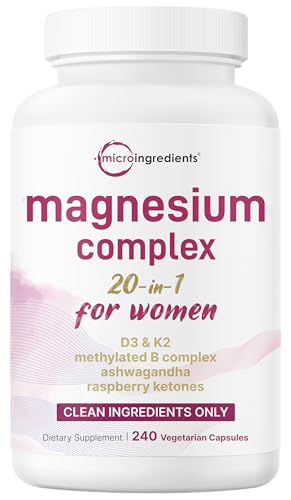
Micro Ingredients delivers the broadest formula in the set, an 800 mg magnesium complex plus vitamin D3, vitamin K2, ashwagandha and more, in a 240-capsule bottle.
Best for: shoppers who want the broadest formula and the longest supply per bottle Skip it if: you want a single, clearly-labelled magnesium form
The maths here is what pulls this pick up: 240 vegetarian capsules, two per serving, 120 servings, four months of daily use from one 6.38 oz bottle. Micro Ingredients calls the formula a 20-in-1 blend of magnesium forms combined with vitamin D3, vitamin K2 and ashwagandha. The brand states the formula is made without fillers, soy, dairy, wheat, gluten and tree nuts, and that ingredients pass third-party lab testing. Sales-rank-wise, it sells faster than three of the other four capsule and powder options here. What holds it back for pregnancy specifically is exactly what makes it attractive for general use: ashwagandha. Ashwagandha in pregnancy is a decision for your clinician, not a bottle. Bring the ingredient panel to your next appointment. If ashwagandha is off the table, Nobi's plain glycinate is the cleaner fit.
Pros:
- 800 mg magnesium complex per serving, per label
- 120 servings per bottle, the longest supply here
- Vegetarian capsules, non-GMO, gluten-free per brand
- Includes vitamin D3 and K2 at no extra product
Cons:
- Contains ashwagandha, which needs clinician sign-off in pregnancy
- 20-in-1 blends are harder to reason about than single-ingredient bottles
- Two-capsule serving size
3. Nobi Nutrition Magnesium Glycinate 500mg — Best budget pick
Nobi is the cheapest pick in this set and the plainest: doctor-formulated, third-party tested magnesium glycinate in a 120-capsule bottle with a 500 mg per-serving claim.

Best for: buyers who want plain magnesium glycinate at the lowest position here Skip it if: you want vitamin D or a pregnancy-specific claim on the label
Nobi's appeal is simple. It is the cheapest of the five, its sales rank of 450 is the strongest in this set, and its bullets stick to a single active: chelated magnesium glycinate at a 500 mg per-serving claim. The brand describes the capsules as small and easy to swallow, and says the formula is vegan, gluten-free, non-GMO and third-party tested. There's no vitamin D3 alongside, no adaptogen, nothing that complicates the conversation with your OBGYN. That's a real advantage during pregnancy, when every added ingredient is another question to answer. The trade-off against BabyRx is that Nobi doesn't claim pregnancy suitability on its label; it's marketed as a magnesium for men and women broadly. Against Pink Stork, you lose the vitamin D3 pairing but gain twice the capsule count.
Pros:
- Lowest price position in this set
- Sells faster than the rest of these picks
- Single active: magnesium glycinate, no add-ins
- Brand states vegan, gluten-free, third-party tested
Cons:
- Label doesn't address pregnancy specifically
- 500 mg claim, not an elemental figure
- No vitamin D or D3 included
4. Pink Stork Magnesium Glycinate with Vitamin D — Best simple daily
Pink Stork pairs magnesium glycinate with vitamin D3 in a 60-capsule bottle from a women's-health brand, in a 2 x 4 x 2 in package.

Best for: someone who wants glycinate plus vitamin D3 and nothing else Skip it if: you need more than a one-month supply per bottle
Pink Stork sits mid-range in this set on price and lands in the middle on ingredient breadth: more than Nobi's single active, less than Micro Ingredients' 20-in-1. The bullets claim 100% Daily Value of magnesium per serving plus vitamin D3, both delivered in a gentle, highly bioavailable glycinate form. The brand describes the formula as non-GMO, gluten-free, soy-free, dairy-free and third-party tested, with a compact 2.89 oz bottle measuring 2 x 4 x 2 in. The tie-in with pregnancy is indirect: Pink Stork is a women's-health brand, but this specific product isn't marketed as a pregnancy supplement on the listing. Where it wins is simplicity of a two-ingredient stack. Where it loses to Nobi is on price and capsule count; where it loses to BabyRx is on the explicit pregnancy positioning.
Pros:
- Two-ingredient stack: glycinate plus vitamin D3
- Compact bottle, easy to travel with
- Women's-health brand focus
- Brand states third-party tested, gluten-free
Cons:
- 60-count is one month at one-a-day
- Mid-range price for a smaller supply
- No explicit pregnancy claim on this listing
5. Perelel Sleep Support Magnesium Powder with Lemon Balm — Best premium
Perelel is the only powder in the set, formulated by OB/GYNs and naturopathic doctors, with a triple magnesium blend and organic lemon balm at 2.3 g per scoop.

Best for: shoppers who prefer a nightly powder with a triple magnesium blend Skip it if: you dislike sweet drinks before bed or want a capsule
Perelel breaks the pattern. It's the only powder here, the only pick that pairs magnesium with a botanical (organic lemon balm), and the only one whose blend combines citrate, glycinate and malate rather than leaning on glycinate alone. The tub weighs 2.96 oz and measures 2.86 x 4.4 x 2.86 in, and the brand's instructions call for one 2.3 g scoop stirred into 8 fl. oz. of water. The listing says the formula is designed by OB/GYNs and naturopathic doctors, aimed at women's wellness across life stages, though it does not name pregnancy the way BabyRx does. Where powder wins is ritual: a warm honey-lemon drink signals wind-down in a way a capsule can't. Where it loses is precision and travel. Against BabyRx you're trading a pregnancy-specific claim for a broader magnesium blend and a herbal add-in.
Pros:
- Triple magnesium blend: citrate, glycinate, malate
- Organic lemon balm for a wind-down ritual
- Doctor-founded women's brand
- Honey-lemon flavor, no capsule needed
Cons:
- No pregnancy-specific claim on this listing
- Requires a glass of water and a scoop each night
- Small 2.96 oz tub for a premium price position
What gluten-free really means on these labels
Every product in this shortlist is described by its brand as gluten-free. What that phrase covers varies:
- Nobi Nutrition lists gluten-free alongside vegan and non-GMO, and states doctor formulation and third-party testing.
- Pink Stork states non-GMO, gluten-free, soy-free and dairy-free, always third-party tested.
- Micro Ingredients states its formula is made without fillers, soy, dairy, wheat, gluten and tree nuts, with 3rd party lab testing.
- BabyRx does not use the phrase gluten-free explicitly in its feature bullets, but the brand markets the gummy as clean and pregnancy-safe.
- Perelel does not name gluten-free explicitly in the feature copy supplied, though the brand's positioning is a clinician-formulated women's line.
If gluten-free is a coeliac-level requirement rather than a preference, check the actual product page for the certification mark before you buy, and if a label is silent, treat that as an unanswered question rather than a yes.
How many capsules or scoops does a bottle last?
The count on the front of the bottle is not the number of days it lasts. Here is what the labels actually work out to at the brand's recommended serving:
- Micro Ingredients: 240 capsules, two per serving, 120 servings.
- Nobi Nutrition: 120 capsules, one per serving typical, around 120 servings.
- Pink Stork: 60 capsules, about a month at one a day.
- BabyRx: 60 gummies, about a month at one a day.
- Perelel: 2.96 oz tub, 2.3 g scoops, roughly a month of nightly use.
That's a real spread. Micro Ingredients and Nobi both run about four times as long as the other three per bottle, which matters when you're already juggling prenatal appointments and don't want another monthly reorder on the calendar.
Powder, gummy or capsule: which format fits pregnancy?
Format matters more in pregnancy than in general use, and the picks split cleanly:
- Gummy (BabyRx): easiest during first-trimester nausea, no water needed. Trades off added sugar.
- Capsule (Micro Ingredients, Nobi, Pink Stork): precise dose, easy travel, cheapest per serving. Trades off swallowing capsules when nausea is bad.
- Powder (Perelel): ritual, warm-drink wind-down. Trades off requiring a glass of water and a scoop at a specific time.
Most shoppers miss that the format is what determines whether you actually take the supplement every day. A perfect capsule you skip half the week is worse than a good-enough gummy you take nightly. Pick the format that fits your routine first, then choose the product within that format.
The verdict
For the specific query of a gluten-free magnesium during pregnancy, BabyRx Calm & Sleep Support is the pick that answers the question on its label, and it does so with magnesium glycinate in a gummy that survives nausea. That combination is why it wins overall despite being the most expensive pick here and the slowest seller in this set.
If your OBGYN is comfortable with a broader formula and ashwagandha is not a concern, Micro Ingredients Magnesium Complex for Women is the runner-up on strength of formula and length of supply: 800 mg complex, 240 vegetarian capsules, 120 servings per bottle, and non-GMO with third-party testing per the brand. It's the value story of the group.
For a plain-vanilla glycinate at the lowest position here, Nobi Nutrition is the honest recommendation, with the caveat that its listing doesn't address pregnancy. And if you'd rather sip than swallow, Perelel is the premium format play. The one pick I'd approach carefully is Pink Stork, only because its 60-count size makes the value harder to justify against Nobi's 120.
FAQ
Is magnesium safe during pregnancy?
Magnesium safety in pregnancy is a question for your OBGYN or midwife, not a supplement listing. Some clinicians recommend magnesium during pregnancy for specific reasons; others prefer you get it from diet and your prenatal. Any product in this shortlist should be raised with your provider before you start it, particularly if you have kidney issues or take medication that interacts with magnesium.
Which magnesium form is easiest on the stomach?
The form easiest on the stomach in this set is magnesium glycinate, the chelated form used by BabyRx, Nobi, Pink Stork and (as part of a blend) Perelel. All four brands describe it as gentler and better absorbed than oxide or citrate. That's a manufacturer claim, not a clinical finding, but the consistency across four independent brands is telling.
Is BabyRx worth it over cheaper glycinate options?
BabyRx is worth the higher price if the OBGYN recommendation for pregnancy on the label matters to you and if a no-water gummy fits your routine during nausea. If you'd already cleared plain glycinate with your clinician and price is decisive, Nobi delivers the same active in a capsule at a lower position, with the trade-off of no pregnancy-specific positioning.
Micro Ingredients vs Nobi Nutrition: which for pregnancy?
Micro Ingredients versus Nobi comes down to how you feel about ashwagandha. Micro Ingredients bundles it into its 20-in-1 blend, which is a plus for general wellness and a question mark for pregnancy. Nobi is a single-active magnesium glycinate. If your clinician hasn't approved ashwagandha in pregnancy, Nobi is the cleaner fit even though Micro Ingredients offers a broader formula.
What should I avoid in a pregnancy magnesium supplement?
Avoid buying anything without checking the full ingredient panel against your prenatal and your clinician's guidance. Blended formulas with adaptogens like ashwagandha, added melatonin, high-dose herbal extracts, or unspecified proprietary blends are the ones to flag first. Pregnancy is when a single-active supplement is easier to reason about than a stack, however impressive the stack looks on the front of the bottle.
If you're leaning BabyRx, screenshot the ingredient panel and send it to your OBGYN before your next appointment. If you're leaning Micro Ingredients for the value, do the same but flag the ashwagandha directly and ask whether the wider formula is a fit for you. Nothing else on this shortlist deserves a purchase without that same check. The reason BabyRx wins here isn't marketing polish, it's that when you already have a prenatal doing most of the work, a magnesium product designed with pregnancy on the label is the one that fits most cleanly into a routine you don't want to complicate.