Best Calcium for Osteoporosis When Pills Are Hard
Six calcium supplements compared on the form of calcium, the dose per serving, and whether the pill goes down easy. Mellk leads on a mini tablet; Bluebonnet leads on citrate.

By Harley GriffithsUpdated 14 min read
On this page
- How I screened these six down
- Best type of calcium for osteoporosis at a glance
- 1. Mellk Calcium Supplement Vitamin D3 1200mg Magnesium Mini — Best overall
- 2. Bluebonnet Calcium Citrate with Vitamin D3 — Best minimal setup
- 3. NBI Osteo-K Bone Support — Best premium
- 4. Standard Process Calcifood — Runner-up
- 5. Generic Calcium Plus with Vitamin D3 600 mg — Best for beginners
- 6. LUAL Spring Valley Calcium 600 mg + Vitamin D3 — Best for pros
- Citrate or carbonate: which form should you look for?
- Does the osteoporosis label mean anything here?
- How much calcium per day, and how many pills?
- What the listings do not tell you
- The verdict
- FAQ
The best type of calcium for osteoporosis in this set is the Mellk Calcium Supplement, because it puts 1200mg of calcium plus vitamin D3 into a mini tablet measuring 0.6in long, which is the pill people actually keep taking. If you'd rather have calcium citrate, the form that's easier on an empty stomach, Bluebonnet Calcium Citrate delivers 1000mg with 800 IU of D3. Price positions here run from an entry pick to two premium ones, and what each tier buys is not always more calcium.
How I screened these six down
I lined up all six listings and compared them on three things only: the form of calcium named on the label, the dose per serving, and whether the pill is described as easy to take. Everything else is noise for this decision.
Here is what got cut or downgraded and why:
- Vague dosing. The LUAL Spring Valley bundle needs 2 softgels for its 1200mg, which is fine, but it ships with an ebook and sells slowest of the six.
- No stated calcium figure. The Standard Process Calcifood wafer lists 100 wafers and a 6.4 oz weight, but no milligram number, so I could not rank it on dose.
- Single-seller listings. The NBI Osteo-K and the Generic softgel each have only one seller, which narrows your options if that seller changes.
What survived is a spread of forms: two citrate picks, several carbonate-style pills, and one whole-food wafer. That spread is the whole point of this comparison.
Best type of calcium for osteoporosis at a glance
| Pick | Calcium form & dose | Pill type | Price |
|---|---|---|---|
Best overall Mellk Calcium Supplement |
1200mg + D3 (claim) | Mini tablet, 0.6in | Check Price |
Best minimal setup Bluebonnet Calcium Citrate |
1000mg citrate + 800 IU D3 | Caplet | Check Price |
Best premium NBI Osteo-K |
1000mg citrate + D + K2 | Veggie capsule | Check Price |
Runner-up Standard Process Calcifood |
Whole-food (claim) | Chewable wafer | Check Price |
Best for beginners Generic Calcium Plus D3 |
600mg + 500 IU D3 | Mini softgel | Check Price |
Best for pros LUAL Spring Valley 600mg |
600mg + 500 IU D3 per softgel | Softgel | Check Price |




1. Mellk Calcium Supplement Vitamin D3 1200mg Magnesium Mini — Best overall
A mini tablet that carries a full 1200mg dose is the one you'll actually finish, and that beats any spec on paper.

Best for: people who gag on large calcium pills Skip it if: you specifically want calcium citrate
The Mellk stands out on one number that matters more than most: pill size. The listing gives each tablet as 0.6in long, 0.3in wide, and 0.17in thick, and Mellk says that small tablet still packs 1200mg of calcium plus vitamin D3 and magnesium. That is the deciding trait for the best type of calcium for osteoporosis, because the supplement that stays in your routine works better than a stronger one you quit.
This is the cheapest pick of the six and the largest count at 186 tablets. Mellk describes the calcium as a patented, highly active form and states production at an NSF-certified facility, both of which are manufacturer claims rather than measured facts. The bottle is pitched at anyone over 3 years old, which tells you it's a general family formula, not an osteoporosis-specific one.
The trade-off is transparency. The form of calcium here isn't named as citrate or carbonate, so you can't compare its absorption directly against the Bluebonnet. You're trading a known form for an easy swallow.
Pros:
- Largest count in the set at 186 tablets
- Mini tablet, 0.6in long, easy to swallow
- 1200mg calcium plus D3 claim per serving
- Cheapest pick of the six
- Sugar-free formula
Cons:
- Calcium form not named on the listing
- Not marketed specifically for osteoporosis
- Absorption claims are unverified marketing
- Only two sellers list it
2. Bluebonnet Calcium Citrate with Vitamin D3 — Best minimal setup
Named calcium citrate at 1000mg with 800 IU of D3, and a clean allergen list, make this the simplest known-form choice.

Best for: anyone told to take calcium citrate on an empty stomach Skip it if: you want vitamin K2 in the same pill
The Bluebonnet is the pick where the form is written on the label. It contains 1000mg of calcium citrate and 800 IU of vitamin D3 per serving, across 180 caplets and 45 servings. Calcium citrate is the form absorbed with or without food, which is why it gets recommended for people who take acid reducers or eat little. That single fact is why it earns a spot separate from the carbonate-style pills.
Its allergen profile is the cleanest listed here: soy-free, gluten-free, non-GMO, kosher certified, and vegetarian friendly, plus free of milk, egg, fish, shellfish, tree nuts, peanuts, wheat, yeast, barley, rice, and sugar. The bottle weighs 1.3 lb and measures 5.75 x 3 x 3 in, and it's a mid price position here.
The trade-off is scope. It's calcium and D3, nothing more, so if you want vitamin K2 in the same capsule, the NBI does that and this doesn't.
Pros:
- Form stated as calcium citrate, 1000mg
- 800 IU vitamin D3 per serving
- Widest allergen-free list in the set
- 45 servings from 180 caplets
Cons:
- No vitamin K2 in the formula
- Only two sellers list it
- Mid price for calcium and D3 only
3. NBI Osteo-K Bone Support — Best premium
The only pick pairing calcium citrate with a high 45mg dose of vitamin K2, and it costs the most for that reason.
Best for: someone who wants D and K2 alongside calcium citrate Skip it if: one seller listing worries you
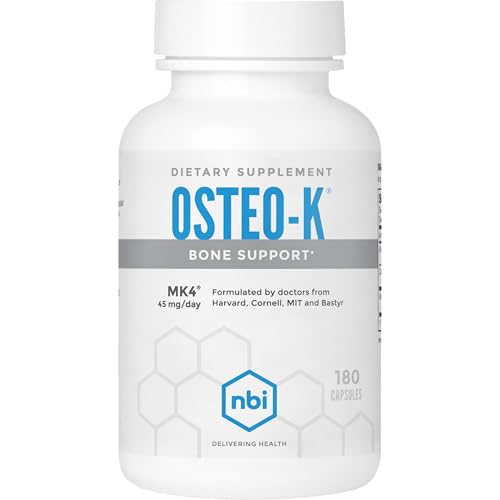
The NBI Osteo-K is the most complete formula in this set on paper. NBI states a daily blend of 1000mg calcium as calcium citrate, 2000 IU vitamin D, and 45mg vitamin K2 as MK4, across 180 veggie capsules weighing 7.2 oz. The K2 is what separates it: none of the other five picks lists it, and NBI says the K2 form is clinically shown to maintain strong bones. Treat that as the manufacturer's claim, not a proven outcome.
This is the most expensive pick of the six and the fastest seller of them, so demand and price track together here. It also uses named calcium citrate, so you get a known form alongside the extra vitamins. For a buyer chasing a single capsule that covers calcium, D, and K2, this is the one that does it.
The trade-off is availability. Only one seller lists it, so if that changes, you're stuck. You also pay a premium for the K2 that a doctor may or may not want you taking.
Pros:
- Only pick with vitamin K2, 45mg MK4
- Named calcium citrate, 1000mg daily
- Highest D dose here, 2000 IU
- 180 veggie capsules, vegetarian-friendly
Cons:
- Most expensive pick of the six
- Only one seller lists it
- K2 benefit claim is unverified
4. Standard Process Calcifood — Runner-up
A chewable whole-food wafer for people who won't swallow a tablet, but the label skips the milligram figure.

Best for: people who prefer a chewable wafer to a tablet Skip it if: you want a stated calcium figure on the label
The Calcifood is the odd one out, and that's its value. Instead of a pill, it's a chewable wafer, 100 to a tub, weighing 6.4 oz in a 2 x 5 x 2 in container. Standard Process suggests two wafers per meal and describes it as a whole-food source meant to help the body build strong bones. For anyone who dreads pills entirely, a wafer you eat is a genuinely different route.
It sits in the premium price positions here, and it's the only pick filed under diet and sports nutrition rather than the calcium category, which tells you it's positioned as a food, not a mineral tablet. The listing repeats the standard line that a diet with calcium and physical activity may reduce osteoporosis risk later in life.
The trade-off is the missing number. Without a stated calcium dose, you can't line it up against the 1200mg Mellk or the 1000mg citrate picks. You're trusting the whole-food framing over a countable figure.
Pros:
- Chewable wafer, no swallowing required
- Whole-food positioning per the brand
- 100 wafers per tub
- Compact 2 x 5 x 2 in container
Cons:
- No stated calcium milligram figure
- Premium price for an uncountable dose
- Two wafers per meal adds up fast
5. Generic Calcium Plus with Vitamin D3 600 mg — Best for beginners
A small, easy-swallow softgel at 600mg is the low-commitment way to start, splitting a daily target into two doses.

Best for: first-time buyers who want a small softgel Skip it if: you need more than 600mg per softgel
The Generic Calcium Plus is the gentle on-ramp. It delivers 600mg of calcium and 12.5 mcg (500 IU) of vitamin D3 per serving across 150 mini softgels, and the listing calls them easy to swallow and free from gluten, lactose, and artificial colors, flavors, and preservatives. A 600mg dose is deliberate: splitting calcium into smaller amounts through the day is how it's typically taken, and this pill fits that pattern.
It's the second-cheapest pick here, behind only the Mellk, so starting costs little. The container measures 5 x 3 x 3 in. The brand shows as Generic, and the listing references Spring Valley mini softgels, so the labeling is a touch mixed.
The trade-off is the low per-pill dose. At 600mg you'll take more than one to reach a common daily target, unlike the single-serving 1200mg Mellk. For a first bottle to see whether calcium sits well with you, that's fine; for a settled routine, the bigger doses are simpler.
Pros:
- Small mini softgel, easy to swallow
- Second-cheapest pick of the six
- Free of gluten, lactose, artificial additives
- 150 softgels per bottle
Cons:
- Only 600mg per serving
- Only one seller lists it
- Mixed Generic and Spring Valley labeling
6. LUAL Spring Valley Calcium 600 mg + Vitamin D3 — Best for pros
A two-softgel routine reaches 1200mg with D3, suited to someone who already dose-tracks, though it ships with an unrelated ebook.

Best for: people who like a two-softgel routine with D3 Skip it if: you avoid softgels or want fast shipping guarantees
The LUAL bundle is for the buyer who already thinks in doses. LUAL states 600mg calcium plus 500 IU vitamin D3 per softgel, and a full 1200mg daily serving from 2 softgels, across 120 rapid-release capsules. The brand describes it as gluten-free, preservative-free, and free of artificial flavors, and links the product to osteoporosis defense when combined with physical activity. That last line is the standard qualified claim, not a promise.
It's a mid price position here. What makes it a "pros" pick is the split-dose structure: you control when you take each softgel, which suits people spacing calcium across meals. The bundle also throws in an unrelated diabetes ebook, which is filler for a bone supplement.
The trade-off is on two fronts. It's the slowest seller of the six, and the ebook padding suggests a listing built for bundling rather than clean bone support. If you want a single-serving pill, the Mellk gets you there in one.
Pros:
- Reaches 1200mg from a 2-softgel serving
- Rapid-release capsule per the brand
- 500 IU D3 per softgel
- Gluten-free, preservative-free formula
Cons:
- Slowest seller of the six
- Bundled ebook is unrelated filler
- Two softgels needed for full dose
Citrate or carbonate: which form should you look for?
The form of calcium is the real deciding criterion, and it's the thing most bottle-front marketing skips. Calcium citrate absorbs with or without food and is the usual pick for people on acid reducers or with a small appetite. Carbonate needs stomach acid and food to absorb well, which suits people who take it with meals.
In this set, the forms split cleanly:
- Named citrate: Bluebonnet and NBI Osteo-K both state calcium citrate on the label.
- Form not stated: the Mellk names a "patented" form without calling it citrate or carbonate.
- Whole-food: Standard Process Calcifood is positioned as a food source, not a named mineral form.
- Softgels: the Generic and LUAL softgels list a milligram dose without naming the salt.
If your doctor told you to take citrate, that instruction alone narrows the six down to two. If no one specified, the easy-swallow Mellk and the small Generic softgel become reasonable. The label's form beats every softer selling point.
Does the osteoporosis label mean anything here?
The word osteoporosis on a supplement listing is a shopping consideration you have to judge yourself, not a promise the product treats anything. Several of these labels use it, and the wording matters.
The LUAL and Standard Process listings both use the qualified phrasing: calcium plus physical activity may reduce the risk of osteoporosis. That is a permitted structure-function claim, not evidence that the product reverses bone loss. The Mellk lists osteoporosis among symptoms it associates with low calcium, which is marketing framing.
None of these six is a medicine, and none should replace advice from a doctor who has seen your bone-density results. The best type of calcium for osteoporosis for you is the one your clinician signs off on, in the form and dose they specify. Use these listings to match that instruction, not to self-diagnose. If you have a diagnosis, bring the label to your next appointment before you commit to a bottle.
How much calcium per day, and how many pills?
Dose per serving is where these six diverge most, and it changes how many pills you swallow. Here's the ranked picture, highest single-serving dose first:
- Mellk, 1200mg in one mini tablet.
- LUAL, 1200mg across 2 softgels.
- Bluebonnet, 1000mg citrate per serving.
- NBI Osteo-K, 1000mg citrate daily.
- Generic, 600mg per softgel.
- Standard Process, unlisted milligram figure.
Two things follow. First, calcium is often taken in split doses because the body absorbs smaller amounts better at once, so a 600mg pill taken twice can be more sensible than 1200mg in one go, depending on your target. Second, the pill count you'll get through matters: the Mellk's 186 tablets last longest here, while the LUAL's 120 softgels at 2 per day run down faster.
Match the dose to what a doctor sets, then check how many servings the bottle holds so you know how often you'll reorder.
What the listings do not tell you
Even after reading the label, gaps remain, and knowing them keeps you from overpaying.
- Elemental versus compound calcium. A "1200mg" figure may mean the compound weight, not the elemental calcium your body counts. The listings don't always clarify this, so the real absorbed amount can differ.
- Seller availability. The NBI Osteo-K and the Generic softgel each show only one seller. Fewer sellers means less resilience if that one changes its listing.
- Form for softgels. The Generic and LUAL give a dose but don't name the calcium salt, so you can't judge absorption the way you can with the two citrate picks.
- The bundled extras. The LUAL includes a diabetes ebook and the Generic mentions a container gift. Neither adds to bone support; both hint at listings built to look fuller than they are.
Read past the front-of-bottle number to the form, the servings, and the seller count. Those three tell you more about value than any dose figure alone.
The verdict
Split the decision by what you've been told to take. If a doctor named calcium citrate, the answer is the Bluebonnet Calcium Citrate: 1000mg of stated citrate, 800 IU of D3, and the cleanest allergen list of the six, at a mid price. If you also want vitamin K2 in the same capsule, step up to the NBI Osteo-K, the only pick here with 45mg of K2 alongside its citrate, though it's the most expensive and has a single seller.
If no form was specified and swallowing pills is your real obstacle, the Mellk is the better default and my overall winner: 1200mg in a 0.6in mini tablet, 186 tablets to a bottle, at the lowest price here. The cutoff is the form instruction. Below it, meaning no doctor named citrate, take the pill you'll finish, and that's the Mellk. Above it, follow the citrate order and pick Bluebonnet or NBI. The premium picks buy you either K2 or a whole-food wafer, not more calcium, so pay up only if you want that specific extra.
FAQ
What is the best type of calcium for osteoporosis on a budget?
The best type of calcium for a budget here is the Mellk, the cheapest of the six, giving 1200mg plus D3 in a mini tablet with 186 to a bottle. The Generic softgel is second-cheapest at 600mg per serving. Both keep starting costs low, though neither names its calcium form the way the citrate picks do.
Is a premium calcium supplement worth it for bone health?
A premium calcium supplement is worth it only when you want the extra it adds. The NBI Osteo-K, the most expensive pick, is the only one here with 45mg of vitamin K2 and a high 2000 IU of D alongside 1000mg of citrate. If you don't want K2, that money buys nothing more, so a mid or entry pick covers the same calcium.
How much calcium is in each serving of these picks?
Each serving varies widely. The Mellk lists 1200mg in one tablet, the LUAL 1200mg across 2 softgels, Bluebonnet and NBI both 1000mg of citrate, and the Generic 600mg per softgel. The Standard Process Calcifood gives no milligram figure. Match the number to the daily target your doctor sets before choosing.
Should I pick Bluebonnet or NBI Osteo-K for citrate?
Choose between Bluebonnet or NBI on the extras. Both use named calcium citrate, Bluebonnet at 1000mg with 800 IU D3, NBI at 1000mg with 2000 IU D and 45mg K2. Pick Bluebonnet for calcium and D3 alone at a mid price. Pick NBI if you want K2 in the same capsule and accept the premium price and single seller.
What mistake do first-time calcium buyers make?
The mistake first-time buyers make is chasing the highest milligram number and ignoring the form and pill size. A large tablet you quit taking helps nothing. Check whether the label names citrate or carbonate, how many servings the bottle holds, and whether the pill is small enough to swallow daily. Those three decide value more than the headline dose.
Start by settling one question: did anyone tell you to take calcium citrate? If yes, the Bluebonnet is your shortest path, with the NBI Osteo-K waiting if you also want K2. If not, the Mellk is the sensible default, because a 0.6in tablet carrying 1200mg is the one that survives a real week of forgetting and rushing. The strongest supplement on the shelf is the one still in your hand a month from now, and the Mellk is built to be that. Bring the label to your doctor, then order the bottle that matches what they say.