Best Calcium Absorption Picks for Women Over 50

Seven calcium supplements ranked by form, dose and bioavailability claims, with a citrate softgel winning and a chocolate soft chew for people who hate pills.

By Harley GriffithsUpdated 17 min read
On this page
- Best calcium absorption at a glance
- How I narrowed seven picks from a crowded shelf
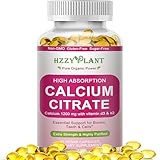
- 1. HZZYPLANT Calcium Supplements for Women Softgels — Best overall
- 2. Caltrate 600 Plus D3 Vitamin D and Calcium Supplement — Best upgrade
- 3. NUTRAHARMONY Calcium 1200mg + Vitamin D3 — Best for families
- 4. Viactiv Calcium + Vitamin D Supplement Soft Chews — Best minimal setup
- 5. LUCNVEM Calcium Citrate Gummies — Best premium
- 6. Vita letuo Calcium Citrate Supplement — Most versatile
- 7. Nextdia Liposomal Calcium AKG Supplement — Best for heavy use
- Citrate, carbonate or AKG: what actually absorbs?
- Does more milligrams per dose mean more calcium absorbed?
- What the labels quietly leave out
- Pairing calcium with vitamin D3, K2 and magnesium
- The verdict
- FAQ
The best calcium absorption comes from the HZZYPLANT Calcium Citrate Softgels, which pack 1200 mg of calcium citrate with vitamin D3, K2 and magnesium in a single softgel that skips the chalky-tablet problem. If you'd rather split your dose across the day and stick with a familiar brand, the Caltrate 600 Plus D3 tablet holds 600 mg of calcium with 20 mcg of D3 per pill and lets you take one with breakfast and one with dinner.
Best calcium absorption at a glance
| Pick | Form | Calcium form & dose | Price |
|---|---|---|---|
Best overall HZZYPLANT Calcium Citrate Softgels |
Softgel | Calcium citrate 1200 mg claim |
Check Price |
Best upgrade Caltrate 600 Plus D3 |
Tablet | Calcium carbonate 600 mg per tablet |
Check Price |
Best for families NUTRAHARMONY Calcium 1200mg + D3 |
Tablet | Citrate + carbonate blend 1200 mg claim |
Check Price |
Best minimal setup Viactiv Calcium + D Soft Chews |
Soft chew | 650 mg per chew claim | Check Price |
Best premium LUCNVEM Calcium Citrate Gummies |
Gummy | Calcium citrate 1200 mg claim |
Check Price |
Most versatile Vita letuo Liquid Calcium Drops |
Liquid | Calcium citrate 1200 mg claim |
Check Price |
Best for heavy use Nextdia Liposomal Calcium AKG |
Softgel | Calcium AKG 1500 mg claim |
Check Price |




How I narrowed seven picks from a crowded shelf
Calcium supplements are one of the messiest supplement aisles on Amazon. Every listing shouts "high absorption", every label calls itself bioavailable, and the doses swing from 600 mg to 1500 mg per serving. I lined up the published specifications side by side, sorted by calcium form, then by dose, then by who the format actually suits.
Here is how the profiles broke out:
- Softgel takers. People who want one dose, done, and can swallow a softgel. HZZYPLANT and Nextdia land here.
- Tablet takers. People who accept a pill and want either a familiar brand or a bigger bottle. Caltrate and NUTRAHARMONY fit.
- No-pill shoppers. People who will not or cannot swallow anything hard. Viactiv chews, LUCNVEM gummies and Vita letuo liquid drops cover this.
Three specifications settled the ranking within each profile: the calcium form, the milligrams per serving, and whether D3 and K2 travel with the calcium. Anything without published D3 was pushed down, because vitamin D is the co-factor that lets the intestines pull calcium into the bloodstream at all. Chalky carbonate-only formulas without D3 were cut.
I also weighted count. A 60-count bottle at two a day lasts a month; a 200-count bottle lasts far longer at the same dose. For a nutrient you're taking every day, that matters.
1. HZZYPLANT Calcium Supplements for Women Softgels — Best overall
A softgel with calcium citrate, D3, K2 and magnesium is the cleanest single-dose route to best calcium absorption on this list.
Best for: adults who want a single citrate softgel with D3, K2 and magnesium Skip it if: you cannot swallow softgels
Calcium citrate is the form most often recommended for people with lower stomach acid, including anyone on acid-blocking medication or over 50, and HZZYPLANT builds its whole pitch around it. The listing states 1200 mg of calcium with vitamin D3, K2 and magnesium packed into a softgel rather than a tablet. HZZYPLANT says the softgel is easier to swallow and gentler on digestion than a chalky pill, which is the complaint that drives most people off calcium in the first place. The bottle is 60 count, framed as a two-month supply, so you're taking one softgel a day.
Within this set, it's the cheapest of the seven and still the only citrate softgel with all four ingredients on one label. The trade-off is dose splitting: the body absorbs calcium best in servings of 500 mg or less, so a single 1200 mg dose is not fully absorbed even from citrate. If that matters to you, a twice-daily tablet like NUTRAHARMONY or Caltrate is a better fit.
Pros:
- Calcium citrate rather than carbonate
- D3, K2 and magnesium on the same label
- Softgel avoids the chalky-tablet problem
- Cheapest of the seven picks here
- One-a-day dosing keeps the routine simple
Cons:
- Single 1200 mg dose exceeds the 500 mg per-serving absorption window
- Only 60 softgels per bottle
- No published weight or dimensions on the listing
2. Caltrate 600 Plus D3 Vitamin D and Calcium Supplement — Best upgrade
A 200-tablet bottle of a long-established carbonate formula with 20 mcg of D3 per tablet, sized for split dosing.

Best for: long-term daily use with a familiar, established formula Skip it if: you need citrate rather than carbonate
Caltrate is the pick that treats calcium as a two-dose habit. Each tablet holds 600 mg of calcium and 20 mcg of vitamin D3, so one with breakfast and one with dinner gives you 1200 mg spread across the day, which fits the 500-mg-per-serving absorption window far better than a single 1200 mg pill. Caltrate says its D3 level is the highest per tablet among leading calcium brands, which supports the co-factor role D3 plays in absorbing calcium at all.
The bottle is 200 count, weighs 0.84 lb, and measures 4.75 x 2.7 x 2.63 in. That's more than three months at two a day. This is calcium carbonate, though, which needs stomach acid to break down, so take it with food and skip it if you're on a proton-pump inhibitor. Within this set, it sells faster than the rest of the seven, and it's the only pick with a stated release year and model number on the listing. The trade-off is form: carbonate over citrate, and no K2 or magnesium in the mix.
Pros:
- 600 mg per tablet fits the absorption window
- 200 tablets per bottle for months of use
- 20 mcg of D3 per tablet
- Sells faster than any other pick in this set
- Full published weight, dimensions and model
Cons:
- Calcium carbonate needs stomach acid and food
- No K2 or magnesium on the label
- Tablets are large and pink-coated
3. NUTRAHARMONY Calcium 1200mg + Vitamin D3 — Best for families
A 180-tablet bottle blending citrate and carbonate with D3 and K2, built for a shared household routine.

Best for: a shared household bottle that lasts three months at two tablets a day Skip it if: large tablets are hard for you to swallow
NUTRAHARMONY splits the difference between the two dominant calcium forms. The listing describes a blend of calcium citrate for bioavailability and calcium carbonate for elemental yield, paired with vitamin D3 and K2. NUTRAHARMONY says the tablets use a slow-release delivery, which is meant to sustain calcium levels between doses rather than dump them all at once. The bottle is 180 count, enough for three months at two tablets a day per person, and the model number NH-CALCIUMTB180 is printed on the label if you need to reorder the same version.
Within this set, this is the only formula that combines both calcium forms on one tablet, which is a real advantage if you want the acid-independent absorption of citrate together with the higher calcium density of carbonate. It's mid-range for this set on price. The trade-offs are the tablet size, which is not published on the listing, and the absence of magnesium.
Pros:
- Citrate and carbonate on the same tablet
- D3 and K2 included
- 180 tablets makes a three-month household supply
- Slow-release claim for sustained levels
- Made in USA with published model number
Cons:
- Tablet size and weight not published on the listing
- No magnesium in the formula
- Two-tablet daily dose to hit the 1200 mg claim
4. Viactiv Calcium + Vitamin D Supplement Soft Chews — Best minimal setup
A chocolate soft chew that delivers 650 mg of calcium with D and K per chew, for people who refuse pills.

Best for: anyone who refuses pills and wants a chocolate chew Skip it if: you avoid added sugar or dairy
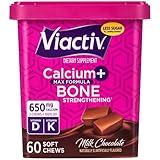
Viactiv is what you buy when the whole pill category is a non-starter. Each soft chew delivers 650 mg of calcium along with vitamin D and vitamin K, and Viactiv says two chews a day provide 100% of the daily recommended calcium. The chews contain milk and taste like milk chocolate. The container holds 60 chews, weighs 1.6 oz, and measures 4 x 3.37 x 3.75 in, so it's compact enough to sit next to a coffee maker.
Within this set, Viactiv is the one buyers choose most often here. That popularity earns it a spot because the chocolate-chew route has a track record for compliance: people actually take it, which is the specification no lab test measures. Viactiv says these have 66% less sugar than the leading calcium gummy, at 1 gram per serving. The trade-offs are real. There's still 1 gram of sugar per chew, the format contains dairy, and this is the smallest daily dose on the list at 650 mg per chew or 1300 mg for two.
Pros:
- 650 mg of calcium per chew
- D and K included
- One of the smallest packages here
- Chocolate flavour helps daily compliance
- Published weight, dimensions and release year
Cons:
- Contains milk and 1 g of sugar per serving
- Calcium form not specified on the listing
- Not vegan and not sugar-free
5. LUCNVEM Calcium Citrate Gummies — Best premium
Peach-flavour citrate gummies stacked with magnesium glycinate, zinc, D3 and K2 across a 60-day supply.

Best for: gummy fans who want citrate plus magnesium, zinc, D3 and K2 Skip it if: you want the lowest sugar option
LUCNVEM is the most loaded formula on the list. The listing states 1200 mg of calcium citrate, 400 mg of magnesium glycinate, 10 mg of zinc, 1000 IU of vitamin D3 and 120 mcg of vitamin K2 per serving. That's a full bone-support stack in a single peach-flavoured gummy. LUCNVEM says citrate is more easily absorbed than carbonate because it doesn't require an acidic environment, which is the same case the citrate softgels here make. It ships as two 60-count bottles for a stated 60-day supply.
Within this set, this is the most expensive pick here and the only one delivering magnesium, zinc, D3 and K2 together in a gummy. If you want everything on one label and you like the format, that's the pitch. The trade-offs are the ones every gummy carries: sugar content that isn't published on the listing, a peach flavour that not everyone likes, and the packaging bulk of two bottles at 4.5 x 2.48 x 2.48 in each.
Pros:
- Calcium citrate, not carbonate
- Adds magnesium glycinate, zinc, D3 and K2
- Peach flavour with a non-sticky claim
- Two bottles for a 60-day supply
- GMP production standard stated
Cons:
- Most expensive pick in this set
- Sugar content not published on the listing
- Two-bottle pack is bulkier to store
6. Vita letuo Calcium Citrate Supplement — Most versatile
Liquid calcium citrate drops with magnesium citrate, D3, K2 and zinc for anyone who cannot use pills or chews.

Best for: people who prefer liquid drops they can mix into a drink Skip it if: you want a grab-and-go format for travel
Vita letuo takes the third route out of the pill problem: liquid. The listing states 1200 mg of calcium citrate with 400 mg of magnesium citrate, plus D3, K2 and zinc, at 30 servings per bottle. Vita letuo says the drops are vegan and differentiated from citrate gummies and capsules by delivering calcium in liquid form, which the brand argues improves absorption. The dropper format lets you split a serving across the day, which is the practical answer to the 500-mg-per-serving absorption window that a single softgel or gummy can't hit.
Within this set, this is the second-cheapest pick here and the only liquid. It's also the only citrate formula that pairs citrate calcium with citrate magnesium, both of which are more acid-independent than their carbonate cousins. The trade-offs are portability and precision: a dropper isn't ideal on a plane, taste is subjective with liquid supplements, and there's no published dimensions or weight on the listing.
Pros:
- Liquid format for anyone who can't swallow pills
- Calcium citrate and magnesium citrate together
- D3, K2 and zinc on the same label
- Second-cheapest of the seven picks
- Vegan formulation
Cons:
- Only 30 servings per bottle
- No published weight or dimensions
- Dropper is less travel-friendly than pills or chews
7. Nextdia Liposomal Calcium AKG Supplement — Best for heavy use
A 1500 mg calcium AKG softgel with sunflower lecithin liposomes and D3, K2 and C for shoppers targeting the AKG form specifically.

Best for: shoppers focused on calcium AKG rather than standard citrate or carbonate Skip it if: you just want a straightforward bone-support formula
Nextdia is the outlier. Instead of citrate or carbonate, it uses calcium alpha-ketoglutarate, a form usually marketed for cellular and vitality benefits rather than raw bone density. The listing states 1500 mg of Ca-AKG per serving, delivered in a liposomal softgel using sunflower lecithin, plus D3, K2 and vitamin C. Nextdia says the liposome improves bioavailability and that AKG offers a wider range of potential benefits than other forms of calcium. That is a manufacturer claim, not a measured absorption figure.
Within this set, Nextdia is the most expensive pick alongside LUCNVEM and the only calcium AKG formula here. It's a niche choice: if you're specifically pursuing AKG for reasons beyond bone support, it's the only option on this list. The trade-offs are that AKG is not the calcium form most bone-health guidance points to, the 120-count bottle at one softgel a day is a four-month supply that ties up money, and the listing publishes no dimensions or weight.
Pros:
- 1500 mg of calcium AKG per serving
- Liposomal delivery claim
- D3, K2 and vitamin C included
- 120 softgels for a long-run supply
- Vegetarian softgel format
Cons:
- Calcium AKG is a niche form for bone support
- Ties premium price to the least-established calcium form here
- No published dimensions or weight on the listing
Citrate, carbonate or AKG: what actually absorbs?
The single most decisive spec in this category is the form of calcium on the label. Most guides compare milligrams. That misleads. A 1200 mg dose of carbonate taken on an empty stomach without adequate acid will absorb worse than an 800 mg dose of citrate. Form matters more than headline dose.
Here is how the three forms in this set behave, based on well-established pharmacology reflected in the listings:
- Calcium citrate. Absorbed with or without food. Doesn't need stomach acid. The default recommendation for anyone over 50, anyone on acid-suppressing medication, and anyone with digestion complaints. HZZYPLANT, NUTRAHARMONY, LUCNVEM and Vita letuo all use citrate.
- Calcium carbonate. Higher elemental calcium per gram, so tablets can be smaller. Needs stomach acid, which means it must be taken with food. Caltrate uses carbonate; NUTRAHARMONY adds carbonate alongside citrate.
- Calcium AKG. Alpha-ketoglutarate bound to calcium, promoted for benefits beyond bone density. Nextdia is the only AKG pick here and pitches it as a broader-benefit form.
Then there's the co-factor question. Vitamin D3 pulls calcium into the bloodstream, K2 helps direct it to bone rather than soft tissue, and magnesium supports the enzymatic machinery. Every pick on this list except Viactiv publishes D3, and five of the seven publish K2 too. That's the checklist worth using.
Does more milligrams per dose mean more calcium absorbed?
More milligrams per dose does not mean more calcium absorbed. The intestines cap absorption at roughly 500 mg per single serving, regardless of what the label says. A 1200 mg softgel taken at once absorbs less than 1200 mg would if it were split into two 600 mg doses across the day.
That's why Caltrate at 600 mg per tablet, taken twice a day, has an absorption advantage over any single 1200 mg dose here. It's also why Viactiv at 650 mg per chew, taken twice a day per its instructions, lines up well with how calcium actually enters the body. Softgels and liquids that state 1200 mg per serving invite you to split the dose if you're willing to remember two moments a day.
The gap between "milligrams on the label" and "milligrams absorbed" is the single biggest reason people take calcium for years without any noticeable effect. If you only ever remember to take one dose, the winning move is a smaller dose taken reliably, not a bigger dose taken once.
What the labels quietly leave out
Listings in this category are noisy and selective. Here are the fields that repeatedly go missing across the seven picks, and what to do about it:
- Tablet or softgel size. Only Caltrate and Viactiv publish dimensions. If swallowing is an issue, that's a data gap that matters.
- Sugar per serving. Viactiv publishes 1 gram per chew. LUCNVEM does not publish a figure. Assume gummies and chews contain some sugar unless the label says otherwise.
- Elemental calcium versus compound weight. "1200 mg" can refer to elemental calcium or to the calcium compound. Read the supplement facts panel on the actual Amazon listing image before you buy.
- Serving size. A 1200 mg claim in a single softgel is different from a 1200 mg claim split across two tablets. Check whether the dose is one unit or two.
- Third-party testing. None of the seven listings state independent lab verification. Every one cites GMP or made-in-USA manufacturing instead.
The other thing labels rarely make prominent: what you should not take calcium with. Iron supplements, thyroid medication and some antibiotics compete with calcium for absorption. Space them apart by two hours at minimum.
Pairing calcium with vitamin D3, K2 and magnesium
Calcium is a team-sport nutrient. Take it alone and you're leaving absorption on the table. Here's the short version of what each co-factor does and which picks include it:
- Vitamin D3 turns on the intestinal transporters that pull calcium out of food and supplements. Every pick here except Viactiv states D3, and Caltrate publishes 20 mcg per tablet.
- Vitamin K2 activates the proteins that route calcium into bone rather than into arteries and soft tissue. HZZYPLANT, NUTRAHARMONY, LUCNVEM, Vita letuo and Nextdia all publish K2 on the label.
- Magnesium supports the enzymatic reactions that convert D into its active form and that regulate calcium balance. HZZYPLANT, LUCNVEM and Vita letuo publish magnesium.
- Zinc, less critical but often bundled, appears in LUCNVEM and Vita letuo.
If you're building a bone-support routine from a single bottle, HZZYPLANT, LUCNVEM and Vita letuo are the three picks that carry all four co-factors on one label. That's a real convenience gain over Caltrate, which is calcium plus D3 only. The trade-off is dose splitting: a single softgel or serving still hits the 500 mg absorption cap.
The verdict
If you want the simplest possible answer, HZZYPLANT Calcium Citrate Softgels is the pick. Citrate absorbs without needing stomach acid, the softgel skips the chalky-tablet problem that kills compliance, and the label carries D3, K2 and magnesium on one bottle. It's the cheapest option here for a full co-factor stack, which is unusual.
The cutoff is dose timing. If you're willing to take two tablets a day and you eat with your doses, Caltrate 600 Plus D3 wins on absorption science: two 600 mg tablets fits the 500-mg-per-serving absorption window that a single 1200 mg softgel does not, and the 200-count bottle stretches for months. Caltrate is the more chemically rigorous answer; HZZYPLANT is the more practical one.
For pill-averse shoppers, Viactiv is the honest recommendation. It contains milk and 1 gram of sugar per chew, but people actually take it, and a supplement you take is worth more than a superior supplement you forget. LUCNVEM is the upgrade path from Viactiv if you want citrate rather than an unspecified form and don't mind the extra outlay. Vita letuo covers the liquid route for anyone who can't do pills or chews, and Nextdia is the specialist AKG pick if that's specifically what you're after.
FAQ
Which calcium form gives the best calcium absorption?
Which calcium form gives the best absorption for most adults? Calcium citrate. It absorbs with or without food, doesn't require stomach acid, and works for people on acid-suppressing medication or with lower stomach acid due to age. Four picks here use citrate. Calcium carbonate has higher elemental density but needs food and stomach acid, so it works best when taken with a meal.
Is a 1200 mg calcium supplement worth it over 600 mg?
Is a 1200 mg calcium supplement worth taking in a single serving? Not really. The intestines cap calcium absorption at roughly 500 mg per single dose, so a 1200 mg softgel taken at once absorbs less than 600 mg twice a day would. Caltrate's split-tablet approach uses this fact directly. If you buy a 1200 mg product, split the serving across the day when the format allows it.
Do I need vitamin D3 and K2 with calcium?
Do I need vitamin D3 and K2 alongside my calcium? Yes for D3, strongly recommended for K2. Vitamin D3 activates the intestinal transporters that absorb calcium in the first place, so calcium without D3 is largely wasted. Vitamin K2 helps route absorbed calcium into bone rather than soft tissue. Every pick here except Viactiv publishes D3 on the label, and five of the seven publish K2 too.
HZZYPLANT softgels or Caltrate tablets: which is better?
HZZYPLANT softgels or Caltrate tablets? HZZYPLANT wins on form and co-factors: calcium citrate with D3, K2 and magnesium in one softgel, cheapest here. Caltrate wins on absorption science: 600 mg per tablet fits the 500 mg absorption window when taken twice daily, plus a 200-count bottle. Take Caltrate if you eat regular meals and can split doses; take HZZYPLANT if you want one softgel a day.
What should I avoid when taking calcium supplements?
What should I avoid taking alongside calcium? Iron supplements, thyroid medication and some antibiotics compete with calcium for absorption, so space them by at least two hours. Skip carbonate on an empty stomach because it needs acid to break down. Don't take a full 1200 mg in one hit if you can split it, and don't stack calcium with a multivitamin that already contains a large calcium dose without checking the total.
Calcium works best as a boring, twice-daily habit rather than a single hero pill. Start with HZZYPLANT if you want the simplest single-softgel route with D3, K2 and magnesium on one label, or Caltrate if you want the more chemically rigorous split-dose approach with a longer-lasting bottle. Take it with food, pair it with vitamin D3, and separate it from iron and thyroid medication by at least two hours. What sets the winner apart isn't the milligram number on the front of the bottle. It's the citrate form, the softgel format, and the co-factors on the same label, which together turn calcium from a specification into something your body can actually use.