Best Vitamin D3 for Women Who Get Little Sun

Five vitamin D3 supplements compared on dose, format, count and third-party certification, with a clear winner and four conditions that change the answer.

By Harley GriffithsUpdated 15 min read
On this page
- Best vitamin d3 for women at a glance
- How I cut the field down to five
- What actually decides your vitamin D3 pick?
- 1. NatureWise Vitamin D3 5000IU Supplement — Best overall
- 2. Nature Made Vitamin D3 1000 IU — Best budget pick
- 3. Nature Made Vitamin D3 5000 IU — Best for families
- 4. THORNE Vitamin D-5 — Most versatile
- 5. MARYRUTH'S Megadose Vitamin D3 Drops — Best premium
- Does a supplement labelled for women do anything different?
- Softgel, capsule or liquid drops?
- How long does one bottle last?
- The verdict
- FAQ
The best vitamin D3 for women in this lineup is the NatureWise Vitamin D3 5000IU Supplement, because 360 mini softgels in a 5.38 x 2.88 x 2.88 in bottle is a full year on one purchase, with NSF contents certification behind the label. If you need a vegan or pill-free option, MaryRuth's 4000 IU drops deliver 100 mcg per 1 mL serving instead. Price tiers here split cleanly by format. Entry money buys plain softgels in big counts. Premium money buys certification, vegan sourcing or liquid dosing, not a bigger number on the front.
Best vitamin d3 for women at a glance
| Pick | Dose per serving | Servings per bottle | Price |
|---|---|---|---|
Best overall NatureWise Vitamin D3 5000IU Supplement |
5000 IU | 360 softgels | Check Price |
Best budget pick Nature Made Vitamin D3 1000 IU |
1000 IU 25 mcg |
300 softgels | Check Price |
Best for families Nature Made Vitamin D3 5000 IU |
5000 IU 125 mcg |
180 softgels | Check Price |
Most versatile THORNE Vitamin D-5 |
5000 IU | 60 capsules | Check Price |
Best premium MARYRUTH'S Megadose Vitamin D3 Drops |
4000 IU 100 mcg |
30 servings (1 fl oz) | Check Price |




How I cut the field down to five
Three things got listings dropped before I compared anything else.
First, no stated dose per serving. Plenty of vitamin D listings bury the number or lump D3 into a multivitamin blend where you cannot tell what you're taking. Every pick here publishes its dose: 1000 IU, 4000 IU or 5000 IU.
Second, no clear serving count. A bottle that says "value size" without a count is impossible to compare against a rival. All five picks state theirs, from 30 servings up to 360 softgels.
Third, blends that hide the D3 behind a proprietary formula. If the label won't separate the vitamin D from the rest, the dose is guesswork.
What survived is five products that split neatly by format and dose. Two are plain Nature Made softgels at opposite ends of the dose range. One is a 360-count higher-dose softgel in olive oil. One is a capsule with a sport certification. One is a liquid.
Two of the five carry an NSF certification of some kind, which is the only independent verification any listing here mentions. That mattered to the ranking.
What actually decides your vitamin D3 pick?
Most guides to the best vitamin D3 for women rank by IU and stop there. That's the wrong first question, because your dose isn't a shopping preference. It comes from a blood test or a clinician, and Nature Made's own listing says its 5000 IU softgel is "for those with higher Vitamin D needs and/or vitamin D deficiency, as determined by a healthcare professional".
Once you know your number, three things actually decide the purchase:
- Format. Softgel, capsule or liquid. This determines whether you can take it at all, and whether it's vegan.
- Servings per bottle. 30 servings versus 360 softgels is a twelvefold difference in reorder frequency at the same daily dose.
- Independent verification. NatureWise states NSF contents certification. Thorne states NSF Certified for Sport, which its listing says screens for compliance with label claims and the absence of nearly 300 banned substances. The other three make no such claim.
Vitamin D3 is cholecalciferol, the form both MaryRuth's and Thorne name on their labels. Thorne's listing argues D3 is better absorbed than D2. That's the manufacturer's position, and it's worth knowing that the whole category has settled on D3 rather than D2.
The size of the pill matters more than shoppers expect. NatureWise calls its softgels "mini". At 1.59 oz for 360 softgels, the individual units are genuinely small.
1. NatureWise Vitamin D3 5000IU Supplement — Best overall
A year of 5000 IU softgels with NSF contents certification is the most complete package in this set.
Best for: someone who wants a year's supply of a higher dose in a small softgel Skip it if: you take a lower daily dose or avoid animal-sourced ingredients
Nothing else here comes close on count. 360 softgels at one per day is twelve months, double the 180 in Nature Made's higher-dose bottle and twelve times MaryRuth's 30 servings. The bottle is 5.38 x 2.88 x 2.88 in and weighs 1.59 oz, so a year of doses still fits in a bathroom cabinet.
Two claims separate it from the cheaper softgels. NatureWise says the softgels are NSF-contents certified, meaning the contents are tested for accuracy and purity. It also says the D3 sits in organic cold-pressed olive oil, processed without heat or hexanes, to help absorption. Vitamin D is fat-soluble, so an oil carrier is a sensible choice rather than a gimmick.
The brand describes the ingredient as naturally sourced and the product as gluten-free, manufactured in the USA under cGMP with third-party audits. That's the mid-range position in this group, and it's the only pick combining a large count with a stated certification.
The trade-off is dose flexibility. At 5000 IU per softgel, there's no easy way down. It's also the slowest-listed pick to change if your requirement drops.
Pros:
- 360 softgels, the largest count in this set
- Stated NSF contents certification
- Organic cold-pressed olive oil carrier
- Described as mini softgels for easier swallowing
- Gluten-free, cGMP facility, third-party audited
Cons:
- 5000 IU per softgel is too high for many people
- Softgel means animal-derived gelatin, so not vegan
- No way to split the dose down
- A year-long bottle sits open a long time
2. Nature Made Vitamin D3 1000 IU — Best budget pick
The cheapest of the five and the only one at a modest 1000 IU, which makes it the sane starting point.

Best for: a first-time daily user starting at a modest dose Skip it if: a clinician has told you to take a higher dose
This is the cheapest pick here and the second-fastest seller of the five, which tells you something about where most shoppers actually land. 1000 IU works out to 25 mcg per softgel, a fifth of the dose in the two 5000 IU options.
300 softgels is a 300-day supply at one per day, the second-largest count in the set. The bottle measures 5.13 x 2.63 x 2.63 in and weighs 3.42 oz, heavier than the NatureWise bottle despite holding 60 fewer softgels.
Nature Made says the softgels help improve calcium absorption and support bone, teeth, muscle and immune health. It also gives a specific instruction the other softgel listings echo: take one daily with water and a meal, ideally one containing dietary fats. That's practical advice for a fat-soluble vitamin, and it's the sort of detail that makes a difference to whether a supplement does anything.
The listing states gluten-free, no added colour and no artificial flavours.
What you give up is verification. Unlike NatureWise and Thorne, this listing claims no independent certification at all. At the lowest price position in the group, that's the compromise.
Pros:
- Cheapest of the five picks
- 300-day supply from one bottle
- 25 mcg dose suits people not treating a deficiency
- Clear guidance to take with a fat-containing meal
- Gluten-free, no added colour or artificial flavours
Cons:
- No third-party certification stated on the listing
- 1000 IU may be well below a clinician's target for you
- Heaviest softgel bottle here at 3.42 oz for 300 count
- Gelatin softgel rules it out for vegans
3. Nature Made Vitamin D3 5000 IU — Best for families
A 5000 IU softgel at the second-cheapest price here, in a compact bottle two adults can share.
Best for: two adults in one household on the same higher dose Skip it if: you want the longest single-bottle supply
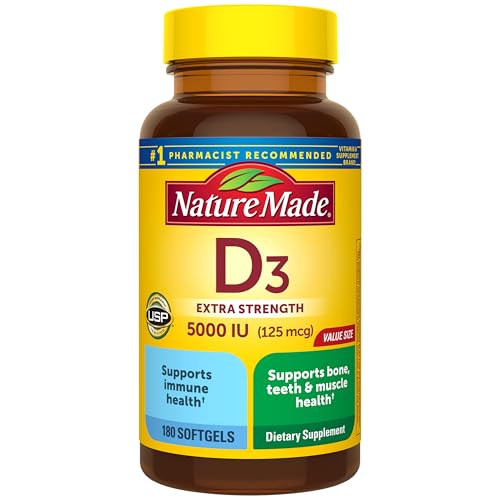
This is the same higher dose as NatureWise and Thorne at the second-cheapest price in the set, which is the whole argument for it. 5000 IU equals 125 mcg per softgel, and the bottle holds 180 of them.
That count is the key number. One person taking one daily gets 180 days. Two adults on the same dose get 90 days, and the low price position makes reordering every three months less painful than it would be with either premium pick.
The bottle is the smallest of the three softgel options at 4.13 x 2 x 2 in, so it travels better than a 360-count container. Nature Made repeats its usual guidance: one softgel daily with water and a meal containing dietary fats. The listing is explicit that this strength is for people with higher vitamin D needs or a deficiency determined by a healthcare professional, which is a more honest framing than most 5000 IU listings manage.
Gluten-free, no added colour, no artificial flavours, same as the 1000 IU version.
Two drawbacks. It's the slowest seller among the three softgel picks here. And like its cheaper sibling, the listing claims no independent testing certification.
Pros:
- Same 125 mcg dose as the two premium picks, at an entry price
- Smallest softgel bottle at 4.13 x 2 x 2 in
- 180-day supply for one adult, 90 for two
- Explicit that the dose suits professionally determined higher needs
- Gluten-free with no added colour
Cons:
- No stated third-party certification
- Half the count of the NatureWise bottle
- Slowest-selling of the three softgel options here
- Not vegan
4. THORNE Vitamin D-5 — Most versatile
The only capsule here, and the only pick carrying NSF Certified for Sport.
Best for: athletes and anyone who wants sport-certified capsules over softgels Skip it if: you want more than two months per bottle
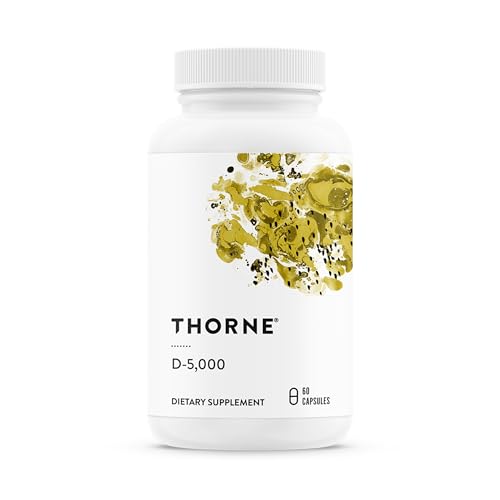
Thorne is the only pick in this group that isn't a softgel or a liquid. It's a capsule, and it's the only one listed under diet and sports nutrition rather than the vitamin D aisle. That's not an accident.
The differentiator is NSF Certified for Sport. Thorne's listing says the product is tested for compliance with label claims and for the absence of nearly 300 substances banned by major athletic organisations. If you compete under a governing body, that certification is the reason to choose this over any other pick here. NatureWise's contents certification verifies purity and accuracy but doesn't cover banned substances.
The dose is 5000 IU as cholecalciferol. Thorne argues D3 is more potent and better absorbed than D2, and that vitamin D supports muscle strength and cellular repair, especially for athletes training indoors without adequate sun exposure. Those are the brand's claims, but the indoor-training point is a real reason people in this position look at supplements.
At 60 capsules and 18 g total, this is the most compact bottle in the set at 2.97 x 1.7 x 1.7 in. It's also the shortest supply among the pill options.
The cost of that certification is duration. 60 capsules is two months against 360 softgels from NatureWise, at a premium price position.
Pros:
- Only NSF Certified for Sport pick here
- Capsule format instead of a gelatin softgel
- Smallest bottle at 2.97 x 1.7 x 1.7 in
- 5000 IU as cholecalciferol, clearly labelled
- Aimed at indoor training and low sun exposure
Cons:
- Only 60 capsules, the shortest pill supply here
- Premium price for the same 5000 IU dose as an entry pick
- Frequent reordering compared with 180 or 360 counts
- No stated organic or vegan credentials
5. MARYRUTH'S Megadose Vitamin D3 Drops — Best premium
The only vegan and only liquid option here, which makes it the answer for anyone who can't take a softgel.

Best for: vegans and anyone who cannot swallow pills Skip it if: you want the lowest cost per day or a long-lasting bottle
Four of these five picks are pills. This one isn't, and that single fact decides it for a lot of shoppers. MaryRuth's makes a point the other listings don't: most D3 supplements are sourced from lanolin, the fat of lamb's wool. This formula is vegan instead.
Per serving of 1 mL, which is 50 drops, you get 100 mcg of vitamin D3 as cholecalciferol at 4000 IU. The other ingredients are organic MCT oil and organic natural pineapple, so the fat carrier is built in. The listing says shake gently, then take up to 1 mL daily by mouth or as a physician directs, and that the formula is for ages 14 and up.
The certification list is the longest here: USDA Organic, Non-GMO, Vegan, Dairy Free, Gluten Free, Nut Free, made in a GMP facility, Clean Label Project Certified, B Corp Certified.
The bottle is 1 fl oz, 28.3 g, at 1.4 x 4.6 x 2 in.
Two real costs. This is the most expensive pick here and the slowest seller of the five. And 30 servings means monthly reordering against a full year from NatureWise, which makes it the priciest way to stay topped up. Liquid dosing also demands you count drops or measure a millilitre, which is fiddler's work compared with swallowing one softgel.
Pros:
- Only vegan pick, not lanolin-sourced
- No pill to swallow, useful if softgels are a problem
- Organic MCT oil supplies the fat for absorption
- USDA Organic, Non-GMO, Clean Label Project Certified
- Flexible dosing down from 50 drops
Cons:
- 30 servings means reordering every month
- Most expensive pick in this comparison
- Measuring 1 mL is less convenient than one softgel
- Formulated for ages 14+, not younger children
- Slowest seller of the five
Does a supplement labelled for women do anything different?
Here's the honest answer: none of these five is formulated specifically for women, and none of them claims to be. Nature Made's listing describes its softgels as "vitamins for adult men and women". The others don't mention sex at all.
That matters when you're searching for the best vitamin D3 for women, because the search returns general D3 products. Vitamin D3 is cholecalciferol regardless of who takes it, and the dose on the bottle is the dose.
What's genuinely worth asking your clinician about:
- Your blood level. Dose follows a test result, not a demographic.
- Calcium and bone health. Three of these listings mention improved calcium absorption and bone support, which is why D3 comes up in conversations about bone density.
- Pregnancy or breastfeeding. Not addressed on any listing here. Ask a professional before choosing a dose.
- Age limits. MaryRuth's drops are formulated for ages 14+. The others say "adults".
Treat a "for women" label anywhere in this category as marketing until the ingredient panel shows something different. In this set, none of them do.
Softgel, capsule or liquid drops?
Format is where this comparison actually splits, so it's worth being blunt about the trade-offs.
Softgels cover three of five picks: both Nature Made bottles and NatureWise. They're the cheapest per day, they come in the biggest counts, and the oil inside supplies the fat that vitamin D needs. They're also gelatin, so they're not vegan.
Capsules are Thorne alone. A capsule shell can be plant-based, and Thorne's certification is the reason to pick it. The bottle is tiny at 18 g.
Liquid drops are MaryRuth's alone. This is the vegan route and the only one that works if pills are a problem. It's also the only pick where you can take less than a full serving by counting fewer than 50 drops.
One practical note that applies to all five: every softgel listing here tells you to take it with a meal containing dietary fats. MaryRuth's builds the fat into the formula with organic MCT oil. Taking a fat-soluble vitamin on an empty stomach is the most common mistake in this category.
How long does one bottle last?
At one serving a day, the spread across these five is dramatic:
- NatureWise: 360 softgels, twelve months
- Nature Made 1000 IU: 300 softgels, ten months
- Nature Made 5000 IU: 180 softgels, six months
- Thorne: 60 capsules, two months
- MaryRuth's: 30 servings, one month
That gap changes the real cost of the premium picks. Thorne sits in the premium price tier and lasts two months. NatureWise sits mid-range and lasts a year. Even before you look at a figure, the reorder maths tells you which one you'll spend more on over a year.
Long bottles have one downside worth naming. A 360-count container stays open for twelve months, so keep it closed, dry and out of direct sun.
The verdict
The NatureWise Vitamin D3 5000IU Supplement wins because it's the only pick here that combines a large count with an independent certification. 360 mini softgels is a year at one per day, the D3 sits in organic cold-pressed olive oil to aid absorption, and NatureWise states NSF contents certification for accuracy and purity. It's mid-range in this group, and it's the one buyers choose most often here.
Two conditions flip that recommendation. First, if you compete in a sport with a banned-substance list, Thorne Vitamin D-5 is the answer instead, because NSF Certified for Sport screens for nearly 300 banned substances and no other pick here claims that. Second, if you're vegan or can't swallow a softgel, MaryRuth's drops are the only option in this set, at 100 mcg per 1 mL serving with organic MCT oil as the carrier.
A third condition is dose. If 5000 IU is more than you need, the Nature Made 1000 IU softgels give you 25 mcg per serving at the lowest price here, across a 300-day supply.
Thorne's exact advantage over the winner is that one certification. Everything else in its favour, the 5000 IU dose and the cholecalciferol form, NatureWise matches at a third of the reorder frequency.
FAQ
Which is the best vitamin D3 for women on a tight budget?
The best vitamin D3 for women on a tight budget is Nature Made Vitamin D3 1000 IU. It's the cheapest of these five picks and holds 300 softgels, a 300-day supply at one daily. Each softgel delivers 25 mcg. The trade-off is that its listing claims no independent testing certification, unlike NatureWise or Thorne.
Is a premium vitamin D3 worth it?
Whether a premium vitamin D3 is worth it depends entirely on what you need beyond the dose. Thorne and MaryRuth's both cost more than the same 5000 IU dose from Nature Made. You're paying for NSF Certified for Sport screening in Thorne's case, or vegan sourcing and organic certification with MaryRuth's drops. If neither applies to you, the premium buys nothing extra.
How much vitamin D3 should I take daily?
How much vitamin D3 you take daily is a question for your doctor, not a listing. These five range from 1000 IU up to 5000 IU per serving. Nature Made's own 5000 IU listing says that strength is for people with higher needs or a deficiency determined by a healthcare professional. Get a blood test first, then match a product to the number.
NatureWise or Thorne: which vitamin D3 should I choose?
Choosing between NatureWise and Thorne comes down to certification type. Both deliver 5000 IU. NatureWise gives you 360 softgels, a year's supply, with NSF contents certification for purity and accuracy. Thorne gives you 60 capsules with NSF Certified for Sport, which screens for nearly 300 banned substances. Athletes under drug-testing rules should take Thorne. Everyone else gets more from NatureWise.
What mistake do vitamin D3 buyers make most often?
The mistake vitamin D3 buyers make most often is taking it on an empty stomach. Vitamin D is fat-soluble. Every Nature Made listing here says to take the softgel with water and a meal containing dietary fats. NatureWise uses organic cold-pressed olive oil and MaryRuth's uses organic MCT oil for the same reason. Skipping the meal wastes the dose.
Start with a blood test, then buy to the number it gives you. That single step saves more money in this category than any price comparison, because a bottle at the wrong dose is a wasted bottle no matter what it cost. Once you have your figure, the NatureWise 360-count softgels are the sensible default: a year of doses, a stated NSF contents certification, and an olive oil carrier that respects how vitamin D actually gets absorbed. If sport testing or a vegan diet rules that out, Thorne and MaryRuth's cover those exact cases and nothing here covers them better.