Best Vitamin D3 for Diabetics: Pick by Daily Dose

Six vitamin D3 supplements compared by IU strength, softgel or tablet format, bottle count and what the labels actually promise. A dosing-first shortlist for anyone managing diabetes alongside a D3 routine.

By Harley GriffithsUpdated 15 min read
On this page
- Who this is not for
- Best vitamin d3 for diabetics at a glance
- How I screened the shortlist
- 1. Nature Made Vitamin D3 1000 IU — Best overall
- 2. Nature Made Vitamin D3 2000 IU — Best upgrade
- 3. Nature's Bounty Vitamin D3 5000 IU Softgels — Most versatile
- 4. NatureWise Vitamin D3 5000IU Supplement — Best for families
- 5. Pure Encapsulations Vitamin D3 125 mcg — Best premium
- 6. MXCZBSM Vitamin D3 K2 Supplement Softgel — Best budget pick
- IU strength: 1000, 2000, 5000 or 10000?
- Softgel, tablet or capsule: does it matter?
- What to ask your doctor before you buy
- How long does one bottle actually last?
- The verdict
- FAQ
The best vitamin D3 for diabetics in this set is Nature Made Vitamin D3 1000 IU, a 300-softgel bottle sized for a conservative daily dose you can hold to for months. If your clinician has asked for a higher intake, Nature Made Vitamin D3 2000 IU covers that ground in tablet form with a 220-day supply. Neither product is diabetes-specific, and none of these six carries a diabetes claim on the label.
Who this is not for
Diabetes is not a supplement problem. Vitamin D3 is not a glucose treatment, and none of the six bottles here says otherwise. The keyword implies a pick that solves something diabetes-specific, and the honest answer is that these are general-population vitamin D3 supplements. If you have type 1 or type 2 diabetes and want to add D3, the choice that matters is the dose, the format and how it fits your other medications, and that is a conversation with the clinician who prescribes for you.
- None of these six products lists a diabetes-specific formula, glucose claim or insulin-related benefit
- The strengths span 1000 IU to 10000 IU per softgel or tablet, a tenfold range you should not pick by feel
- Two products combine D3 with K2, which interacts with warfarin and other anticoagulants
- The category on Amazon is general Vitamins and Vitamin D, not medical nutrition
Read the rest of this guide as a shortlist of well-specified D3 products at different doses and formats. Bring the one your clinician approves.
Best vitamin d3 for diabetics at a glance
| Pick | Strength | Count & format | Price |
|---|---|---|---|
Best overall Nature Made Vitamin D3 1000 IU |
1000 IU (25 mcg) | 300 softgels | Check Price |
Best upgrade Nature Made Vitamin D3 2000 IU |
2000 IU (50 mcg) | 220 tablets | Check Price |
Most versatile Nature's Bounty Vitamin D3 5000 IU |
5000 IU | 240 softgels | Check Price |
Best for families NatureWise Vitamin D3 5000IU |
5000 IU | 360 mini softgels | Check Price |
Best premium Pure Encapsulations Vitamin D3 125 mcg |
5000 IU (125 mcg) | 120 capsules | Check Price |
Best budget pick MXCZBSM Vitamin D3 K2 10000 IU |
10000 IU D3 + 200 mcg K2 claim | 120 softgels | Check Price |


How I screened the shortlist
I pulled six vitamin D3 listings that a diabetic buyer is likely to see when searching, then cut on three grounds. First, products with no published strength on the listing were out. Second, gummies and drops were set aside so the comparison stayed on softgels, tablets and capsules where the per-piece dose is unambiguous. Third, any listing that made a direct disease claim would have been cut on Amazon policy grounds, and none of these did.
What survived is a strength ladder: 1000 IU, 2000 IU, two at 5000 IU, one plain D3 capsule at 5000 IU, and a 10000 IU D3 with K2 combination. That ladder is the real spine of this guide. Everything else, brand, softgel or tablet, bottle count, matters after the dose is right.
1. Nature Made Vitamin D3 1000 IU — Best overall
A conservative daily dose in the longest-supply bottle here, from a brand with the most published specifications of the six.
Best for: a conservative daily dose you can take for months without rethinking it Skip it if: your clinician has told you to take a higher weekly or daily dose
Nature Made sizes this bottle for the long haul: 300 softgels of 1000 IU (25 mcg), which the listing calls a 300-day supply. That is the longest single-bottle run in this set. Each softgel delivers 25 mcg of vitamin D3, the cholecalciferol form, and Nature Made says one softgel taken with a meal that contains dietary fat aids calcium absorption. The bottle weighs 3.42 oz and measures 5.13 x 2.63 x 2.63 in, so it takes a normal cabinet slot.
For a diabetic buyer, the appeal is caution. 1000 IU is the lowest strength on the shelf here, which makes it the least likely to overshoot what a clinician approves. The listing lists it as gluten free with no colour added and no artificial flavours. The trade-off against the two 5000 IU picks is obvious: if your target dose is 5000 IU, you would take five of these a day, which is neither elegant nor cheap.
Pros:
- Lowest strength here, easiest to titrate under medical guidance
- 300 softgels, the longest single-bottle supply in the set
- Full published specifications: weight, dimensions, model, release
- Gluten free with no added colour or artificial flavours
- Mainstream brand widely stocked
Cons:
- 1000 IU may be too low if a higher daily dose is prescribed
- Softgels contain gelatin, so not vegan
- No K2 in the formula
2. Nature Made Vitamin D3 2000 IU — Best upgrade
A middle-of-the-road strength in tablet form from the same brand, with a 220-day supply per bottle.

Best for: someone who wants a mid-range daily strength in tablet form Skip it if: you struggle to swallow tablets and prefer softgels
If 1000 IU is too low and 5000 IU is too high, this is the step between them. Each tablet carries 2000 IU (50 mcg), and the bottle holds 220 tablets, which Nature Made calls a 220-day supply. Weight is 2.88 oz, dimensions are 4.38 x 2.44 x 2.44 in. The format is a tablet, not a softgel, which matters if you swallow tablets easily and prefer a gelatin-free option. Nature Made repeats the guidance to take one with a meal that contains dietary fats so calcium absorption is supported.
Nature Made also references a clinical claim about 2000 IU D3 helping slow biological aging of cells over four years. Take that as the manufacturer's summary of one study, not a personal promise. Against the 1000 IU sibling, this pick doubles the daily intake without shifting brand or format complexity. Against the 5000 IU softgels below, it gives you more room to sit between doses your clinician sets.
Pros:
- 2000 IU is a common target when clinicians move up from 1000 IU
- Tablet format for those who prefer no gelatin softgel
- 220-day bottle covers most of a year
- Full published specifications
- Same brand and dosing guidance as the 1000 IU pick
Cons:
- Tablets can be harder to swallow than softgels for some
- No K2 co-factor
- Cited aging claim is a manufacturer summary, not verified here
3. Nature's Bounty Vitamin D3 5000 IU Softgels — Most versatile
A high-strength softgel from a mainstream drugstore brand with a 240-count bottle.

Best for: a high-strength softgel from a mainstream drugstore brand Skip it if: 5000 IU is more than your care team recommends
Nature's Bounty puts 5000 IU per rapid-release softgel in a 240-count bottle. The bottle weighs 1.6 oz and measures 4.35 x 2.31 x 2.31 in, so it is compact. Nature's Bounty says the formula is non-GMO and gluten-free, with no sugar, no artificial colours and no artificial sweeteners. The brand's D3 marketing leans on general immune and bone support, using the standard cholecalciferol form.
Versatility here means it is the easiest of the 5000 IU options to walk into a pharmacy and cross-reference. If a clinician tells you to take 5000 IU daily, this bottle covers about eight months at one softgel per day. Against the NatureWise 5000 IU bottle, this one has a smaller count and a longer track record on drugstore shelves. Against Pure Encapsulations, it uses a softgel with a manufacturer-listed formula rather than a stripped-back capsule.
Pros:
- 5000 IU per softgel, a common target strength
- 240-count bottle, roughly eight months at one a day
- Non-GMO and gluten-free per the listing
- Rapid-release softgel format
- Widely recognised drugstore brand
Cons:
- Too high for anyone whose clinician wants a lower daily intake
- No K2 co-factor for those who want the pair
- Fewer softgels than the NatureWise 360-count bottle
4. NatureWise Vitamin D3 5000IU Supplement — Best for families
The largest 5000 IU bottle here, formulated with organic olive oil and NSF contents-certified per the listing.

Best for: a household that wants a long-lasting bottle of 5000 IU mini softgels Skip it if: you want the cheapest option per softgel here
NatureWise ships 360 mini softgels of 5000 IU per bottle. That is 50% more softgels than Nature's Bounty at the same strength, in a bottle weighing 1.59 oz and measuring 5.38 x 2.88 x 2.88 in. NatureWise says each softgel is formulated with organic, cold-pressed olive oil, which the brand states is used without heat or hexanes to help absorption. The listing calls the product NSF contents-certified and says it is manufactured in a USA facility that follows cGMP with independent third-party audits.
The family framing is practical: if two adults in one home both take 5000 IU daily, a 360-count bottle stretches further than 240. It sells faster in this set than the two Nature Made picks. Against the Nature's Bounty softgel, NatureWise adds the olive-oil carrier and the NSF contents mark. Against Pure Encapsulations, it costs less per softgel and comes in a much larger bottle. The strength is the same 5000 IU that only some diabetic buyers will actually be told to take.
Pros:
- 360 mini softgels, the largest 5000 IU bottle in the set
- Organic cold-pressed olive oil carrier per the listing
- NSF contents-certified per the manufacturer
- USA-manufactured with independent third-party audits claimed
- Sells faster than the other Nature Made and Pure Encapsulations picks here
Cons:
- 5000 IU is high; unsuitable if a lower daily target is set
- Sits in the premium price position of this set
- No K2 co-factor
5. Pure Encapsulations Vitamin D3 125 mcg — Best premium
A capsule from a practitioner brand that markets its formula on what it leaves out as much as what it puts in.

Best for: shoppers who want an allergen-free capsule from a practitioner brand Skip it if: you would rather have more softgels for the money
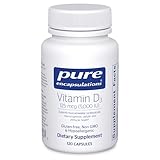
Pure Encapsulations delivers 5000 IU (125 mcg) per capsule in a 120-count bottle weighing 1.45 oz, dimensions 1.1 x 3.7 x 1.8 in. The pitch is minimalism: the brand says its products are free from common allergens, artificial or unnecessary ingredients, and GMOs. The listing lays out bone health, immune support, cardiovascular and brain-health language, all standard vitamin D3 territory phrased carefully.
For diabetic buyers with sensitivities, the appeal is a shorter ingredient list. The trade-off is size and price position. It is the most expensive pick here and holds the fewest units at this strength: 120 capsules against NatureWise's 360 softgels. At one capsule daily it lasts four months. Pure Encapsulations tends to sit on functional-medicine practitioner shelves, so if your clinician already stocks the brand this is a familiar bottle to bring home.
Pros:
- 5000 IU in a capsule, useful if you avoid gelatin softgels
- Manufacturer states no common allergens, artificial ingredients or GMOs
- Practitioner-brand credibility
- Compact bottle
- Stripped-back formula
Cons:
- Highest price position in this set
- Only 120 capsules, the smallest bottle at 5000 IU here
- Fewest published specifications among the branded picks
6. MXCZBSM Vitamin D3 K2 Supplement Softgel — Best budget pick
The only D3-and-K2 combination in the set, and the only 10000 IU strength.

Best for: trying a combined D3 and K2 softgel without committing to a big bottle Skip it if: you want a brand with a long track record and full published specs
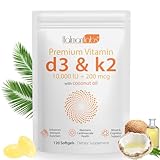
MXCZBSM is the outlier. The listing says each softgel carries 10000 IU of vitamin D3 with 200 mcg of vitamin K2, and the pouch is described as a 60-day supply of 120 softgels, so the label implies two softgels a day. The brand says coconut oil is included in the softgel to support absorption, and that ingredients pass third-party lab tests. Published specs are thinner than the other five: no listed weight, no dimensions, no model number.
For a diabetic buyer, two cautions apply. First, 10000 IU is a high daily amount and not a starting point without medical guidance. Second, vitamin K2 interacts with warfarin and some other anticoagulants, which is a conversation to have with the prescriber before taking anything containing K2. The upside is the price position: it is the cheapest of the six, useful for a short trial if the K2 pairing is what you were told to try.
Pros:
- Only combined D3 and K2 formula here
- Cheapest of the six per bottle
- Coconut oil carrier per the listing
- 120 softgels described as a 60-day supply
- 10000 IU claim per softgel for those on high-dose plans
Cons:
- 10000 IU is high; not a self-directed starting dose
- K2 can interact with warfarin and similar anticoagulants
- Fewer published specifications than the other five picks
- The slowest seller of the six in this set
- Little-known brand compared with Nature Made and Nature's Bounty
IU strength: 1000, 2000, 5000 or 10000?
The strength on the front of the bottle is the whole decision. Everything else, brand, softgel or tablet, olive oil or coconut oil, is secondary. The best vitamin D3 for diabetics is the one whose daily IU matches what your prescriber has agreed with you, in a format you will actually take.
Here is how the six picks line up as a strength ladder:
- 1000 IU (25 mcg): Nature Made Vitamin D3 1000 IU. Conservative, easy to stack under medical guidance.
- 2000 IU (50 mcg): Nature Made Vitamin D3 2000 IU. A common step up when 1000 IU is not enough.
- 5000 IU (125 mcg): Nature's Bounty, NatureWise and Pure Encapsulations. High daily strength, usually for people with documented insufficiency.
- 10000 IU (250 mcg claim): MXCZBSM D3 with K2. Very high per softgel and paired with K2 that has its own interactions.
If you do not know your current 25-hydroxyvitamin D level, you do not know which rung is right. Ask for the blood test first, then pick the bottle.
Softgel, tablet or capsule: does it matter?
Format matters for two practical reasons: swallowing and diet. Softgels are usually easier to swallow, especially at high strength, and they carry the vitamin in an oil that the manufacturers say aids absorption. Tablets are typically smaller by weight and often cheaper per unit, and they suit anyone who prefers a gelatin-free option. Capsules sit between the two: powder inside a shell, easy to swallow, and often chosen by brands that want to keep the ingredient list short.
- Softgels here: Nature Made 1000 IU, Nature's Bounty 5000 IU, NatureWise 5000 IU, MXCZBSM 10000 IU D3/K2
- Tablets here: Nature Made 2000 IU
- Capsules here: Pure Encapsulations 5000 IU
If you take other medications with meals, the manufacturers all point to a meal containing dietary fat as the right moment for D3. That is because D3 is fat-soluble. It is not a diabetes-specific instruction, and it does not change insulin timing on its own.
What to ask your doctor before you buy
Vitamin D3 sits close to other things a diabetic buyer manages daily. A five-minute conversation before you order saves months of guesswork.
- What is my current 25-hydroxyvitamin D level, and what target should I aim for?
- What daily IU do you recommend, and for how long before we retest?
- Are any of my current medications affected by vitamin D3 or K2 co-factors?
- Should I take D3 with breakfast, lunch or dinner given my insulin or oral medication schedule?
- Do I need to watch calcium intake at the same time?
None of these questions has a generic answer. The bottle you buy should be the one that fits the answers you get, not the one you saw first.
How long does one bottle actually last?
The count on the label tells you nothing until you divide it by your daily dose. At one piece per day the six picks land like this: Nature Made 1000 IU lasts 300 days, NatureWise 5000 IU 360 days, Nature's Bounty 5000 IU 240 days, Nature Made 2000 IU 220 days, Pure Encapsulations 5000 IU 120 days, MXCZBSM 10000 IU D3/K2 60 days at the two-per-day dose the label implies.
- Longest single-bottle run in this set: NatureWise, 360 softgels at 5000 IU
- Shortest run at the label's suggested cadence: MXCZBSM, 60 days
- Best match to a doctor's "take one a day for a year" plan: Nature Made 1000 IU or NatureWise 5000 IU
If you split doses across household members, halve those numbers accordingly. A 300-day bottle taken by two adults is a 150-day bottle.
The verdict
The best vitamin D3 for diabetics in this shortlist is Nature Made Vitamin D3 1000 IU. It is the lowest strength here, at 25 mcg per softgel, in the longest-supply bottle at 300 softgels, from a brand that publishes the most complete specifications of the six. If a clinician has cleared you for a higher daily intake, the cutoff is the number on the prescription pad. Below 2000 IU per day, the 1000 IU bottle is the easiest to titrate. At 2000 IU, Nature Made Vitamin D3 2000 IU covers the same ground in tablet form with a 220-day supply. At 5000 IU, choose between NatureWise Vitamin D3 5000IU for the largest bottle in the set, Nature's Bounty Vitamin D3 5000 IU Softgels for the mainstream drugstore option, or Pure Encapsulations Vitamin D3 125 mcg for the stripped-back capsule. MXCZBSM Vitamin D3 K2 at 10000 IU is the pick you buy when a clinician has specifically asked for that pairing, not before. None of these bottles treats diabetes. All of them offer a form and a strength of D3, and the choice belongs to you and the person who reads your bloodwork.
FAQ
Is vitamin D3 safe for diabetics?
Vitamin D3 is safe for most adults at the daily strengths sold on Amazon, but "most adults" is not the same as "you". People with diabetes often take other medications that can interact with fat-soluble vitamins or with K2 co-factors. Ask the clinician who manages your diabetes before starting any D3 supplement, especially at 5000 IU or 10000 IU, and share the exact bottle you plan to buy.
What strength of vitamin D3 should a diabetic take daily?
What strength you take daily depends on your current 25-hydroxyvitamin D blood level, not on a headline number. The six picks here span 1000 IU to 10000 IU per piece. Nature Made 1000 IU is the most conservative starting point. Nature Made 2000 IU is a common middle step. The three 5000 IU picks and the 10000 IU combination are typically used only when insufficiency has been measured and a clinician has signed off.
Is Nature Made 1000 IU or NatureWise 5000 IU the better pick?
Nature Made 1000 IU is the better pick when you want the lowest daily strength in this set and a 300-softgel bottle to match. NatureWise 5000 IU is the better pick when a clinician has agreed on the higher strength and you want the largest available bottle, 360 mini softgels formulated with organic olive oil per the listing. The right one for you is decided by your target daily IU, not by brand.
Should I choose D3 with K2 or plain D3?
Choose D3 with K2 only if your clinician has recommended the pairing. The MXCZBSM softgel is the only D3-and-K2 combination in this set, and the brand says it carries 200 mcg of K2 alongside 10000 IU of D3. Vitamin K2 can interact with warfarin and some other anticoagulants, which are common in older adults with diabetes. Plain D3 keeps the interaction picture simpler.
How long does a vitamin D3 bottle last?
How long a vitamin D3 bottle lasts is the count divided by your daily dose. At one piece a day, Nature Made 1000 IU covers 300 days, NatureWise 5000 IU covers 360 days, Nature's Bounty 5000 IU covers 240 days, Nature Made 2000 IU covers 220 days, Pure Encapsulations 5000 IU covers 120 days and MXCZBSM 10000 IU D3/K2 covers 60 days at the two-per-day cadence the label implies.
If your bloodwork is due, book the retest before you finish the bottle you are on. A vitamin D3 routine is not something to leave running for a year on autopilot when you also manage blood glucose day to day. The best vitamin D3 for diabetics is the one that fits into that bigger picture: the strength your clinician chose, the format you can swallow with your usual meal, the bottle size that lets you retest without gaps. Nature Made 1000 IU is the default that fits the most people in this shortlist. Take the list and the numbers into your next appointment, and let the answers you get pick the exact bottle.