Best Vegan Vitamin C for Teens: Codeage Leads

Five vegan vitamin C options for teenagers, ranked by dose per serving, format and how long a bottle actually lasts. Codeage takes the top spot on published dose and its botanical blend.

By Harley GriffithsUpdated 17 min read
On this page
- Best vegan vitamin C for teens at a glance
- How I screened these five listings
- Does a teen actually need a teen-labelled vitamin C?
- 1. Codeage Teen Vitamin C+ Supplement — Best overall
- 2. Viteey Vitamin C Gummies for Adults & Teens with Zinc & — Best premium
- 3. MegaFood C Defense Vitamin C Gummies — Most versatile
- 4. Nature's Nutrition Vitamin C Gummies — Best budget pick
- 5. MaryRuth's Teen Multivitamin Gummies — Best for families
- Capsule or gummy: which format sticks?
- How long does one bottle really last?
- What the labels don't tell you
- The verdict
- FAQ
The best vegan vitamin C for teens is Codeage Teen Vitamin C+, which pairs 250 mg of ascorbic acid per serving with zinc, quercetin, rosehips and elderberry in 60 capsules. If capsules are out of the question, Viteey's 120-gummy pack matches that 250 mg figure in chewable form. This category is not for a teen who already eats citrus daily and has no gap to fill. It's for the household that has decided to add one, and now has to pick a format that a 15-year-old will actually take twice a month, let alone every day.
Best vegan vitamin C for teens at a glance
| Pick | Vitamin C per serving | Format | Price |
|---|---|---|---|
Best overall Codeage Teen Vitamin C+ Supplement |
250 mg claim | 60 capsules | Check Price |
| 250 mg claim (2 gummies) | 120 gummies, 2 bottles | Check Price | |
Most versatile MegaFood C Defense Vitamin C Gummies |
180 mg claim (2 gummies) | 70 gummies | Check Price |
Best budget pick Nature's Nutrition Vitamin C Gummies |
90 mg claim | 60 gummies | Check Price |
Best for families MaryRuth's Teen Multivitamin Gummies |
Multivitamin blend | 60 gummies, 30 servings | Check Price |


How I screened these five listings
I started from one filter and worked down. Every pick had to be described as vegan on its own listing, because that's the constraint in the search and the one thing a gelatin gummy quietly fails.
Here's what I compared, in order:
- Vegan status as stated on the listing. All five say vegan. Nature's Nutrition and MaryRuth's both specify pectin instead of gelatin, which is the mechanism behind the claim.
- Published vitamin C per serving. Codeage and Viteey both claim 250 mg. MegaFood claims 180 mg. Nature's Nutrition claims 90 mg and calls that the full daily value.
- Format and serving size. Two of these need two units per serving, which changes how fast a bottle empties.
- Count and supply length. From 60 units up to 120.
- What else is in the bottle. Zinc appears on three listings. Echinacea, elderberry, quercetin and rosehips appear once each.
What got cut: anything without a vegan statement, and anything whose listing gave no vitamin C figure at all. That second filter is stricter than it sounds. A supplement that won't print a milligram number on the front of the box isn't a supplement you can compare.
One honest note on the search itself. "Teens" is a marketing label here, not a regulated category. Two of these five put a teen age range on the bottle. The other three are family-format products that name teens among the people who can take them. I've flagged which is which in every section below rather than pretending all five were built for a 14-year-old.
Does a teen actually need a teen-labelled vitamin C?
Not necessarily, and this is where most shopping for the best vegan vitamin C for teens goes sideways. Only Codeage states an age range on the label, 12 to 18. MaryRuth's is named for teens. The other three are general-population products whose listings mention teens as one group among several.
MegaFood's listing is explicit about it: adults, teens and children four and older take two chewables daily. That's the same serving for a 45-year-old and a 12-year-old. Nature's Nutrition says the same thing in different words, naming kids, teens and adults on one bottle.
So what does the teen label buy you? Two things, at most:
- A dose chosen with a smaller body in mind. Codeage's 250 mg sits below what a lot of adult vitamin C runs at, which is a deliberate choice rather than a shortfall.
- A formula built around teen-specific concerns. MaryRuth's covers vitamin A, vitamin D3 and zinc, which its listing ties to skin, bones, vision and immune function.
What it doesn't buy you is a different molecule. Ascorbic acid is ascorbic acid. If a family bottle gives an appropriate serving and your teen will take it, the age printed on the front is packaging.
The practical read: buy the teen-labelled product if you want the dosing decision made for you. Buy the family bottle if two or three people in the house will use it.
1. Codeage Teen Vitamin C+ Supplement — Best overall
The only pick here built for a stated age range, and it carries the highest published vitamin C figure in the set alongside four botanicals.
Best for: a teen who can swallow a capsule and wants the highest published dose here Skip it if: capsules are a non-starter
Codeage is the only pick in this group that prints an age range, 12 to 18, on the bottle. That matters less than the formula, which is where it separates itself. The listing claims 250 mg of ascorbic acid per serving, tying Viteey for the top figure here, and Codeage delivers it in one capsule rather than two chewables.
The supporting cast is the real differentiator. Codeage says the blend includes zinc, quercetin dihydrate, rosehips extract and elderberry powder, plus a citrus bioflavonoid complex drawn from grapefruit, lemon and orange fruit extracts. No other pick in this set stacks four botanicals alongside the vitamin C. The brand also describes a liposomal delivery using phospholipids from non-GMO sunflower lecithin, and calls the supplement vegan, non-GMO, soy-free, dairy-free and gluten-free, manufactured in the USA.
At 60 capsules the listing calls this a two-month supply, which points to one capsule daily. That's the cleanest routine of the five: one unit, once, done.
The trade-off is format. This is the only pick here that isn't chewable, and a capsule is a hard sell to a teen who has spent a decade on gummy vitamins. It also sits in the upper price tier for a 60-count bottle, where Viteey's 120 gummies come across as more product for the money.
Pros:
- Highest published vitamin C figure here at 250 mg
- Only pick with a stated 12 to 18 age range
- Four botanicals plus citrus bioflavonoids per the listing
- One capsule per serving, not two units
- Vegan, non-GMO, soy-free, dairy-free, gluten-free per brand
Cons:
- Only non-chewable option in this set
- Premium price position for a 60-count bottle
- Just two sellers list it
- Slowest mover of the five in its category
2. Viteey Vitamin C Gummies for Adults & Teens with Zinc & — Best premium
Matches the top 250 mg dose in gummy form and ships the largest count in the set at 120 units.
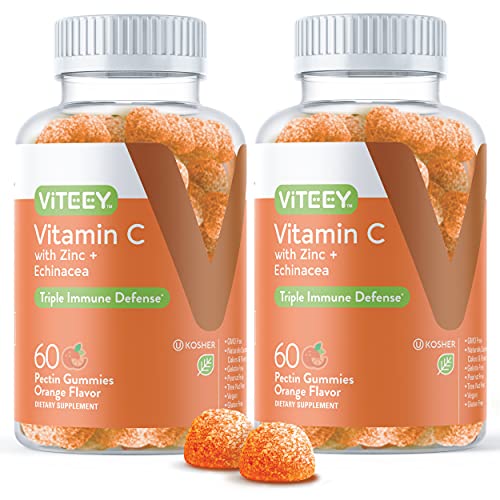
Best for: a household that wants a matching 250 mg dose in chewable form Skip it if: you want the smallest bottle and lowest outlay
Viteey solves the problem Codeage creates. It claims the same 250 mg of vitamin C, but as two orange-flavoured gummies rather than a capsule. For a teen who won't swallow pills, that's the whole decision.
The count is the other headline. Viteey ships 120 gummies across two bottles, double what Codeage, Nature's Nutrition and MaryRuth's provide and 50 more than MegaFood. The listing describes that as a two-month supply at two gummies daily and adds that 2 to 4 gummies daily is the recommended range, which is worth reading carefully. Take four and the 120 becomes a one-month supply.
Alongside the vitamin C the listing specifies zinc at 10 mg and echinacea at 4 mg, based on a two-gummy serving. Viteey calls the product kosher certified, peanut-free, tree nut-free, non-GMO, gluten-free, gelatin-free and vegan. It's the only pick here with echinacea and the only one naming a kosher certification.
Against the field, Viteey carries the highest price position of the five, and the two-gummy serving means the sugar-free question matters. Unlike Nature's Nutrition and MaryRuth's, this listing makes no sugar-free claim, so a teen chewing four a day is eating something. Note also that the listing names adults and teens generally rather than a specific age range.
Pros:
- Ties the top 250 mg vitamin C figure in gummy form
- Largest count here at 120 gummies
- Zinc 10 mg and echinacea 4 mg per two-gummy serving
- Only kosher certified pick in the set
- Gelatin-free and vegan per the listing
Cons:
- Highest price position of all five
- No sugar-free claim on the listing
- Needs two gummies to hit the stated dose
- No stated age range, just adults and teens
3. MegaFood C Defense Vitamin C Gummies — Most versatile
The only pick with a published third-party testing scope, and its dosing instructions cover a teen and a four-year-old from the same bottle.

Best for: families dosing a teen and a younger sibling from one bottle Skip it if: you want the full daily value in a single serving
MegaFood is the pick I'd hand to a family rather than an individual. The listing states that adults, teens and children four and older take two chewables daily, which means one 70-count bottle covers more than one person in the house without a second purchase.
Vitamin C is claimed at 180 mg per serving, putting it between Viteey's 250 mg and Nature's Nutrition's 90 mg. MegaFood also says each serving includes 120 mg of orange, cranberry, blueberry and ginger root, describing the product as made with real food. The listing ties vitamin C to collagen production for skin health and to increased iron absorption from food, both worth knowing if a teen is eating a plant-based diet.
The testing claim is what earns this its spot. MegaFood states third-party testing for 150 chemical substances and the top nine food allergens including milk, eggs, peanuts, tree nuts, soy and wheat. No other listing in this set publishes a testing scope with a number attached. The flavour is tangy citrus, and the listing says it can be taken any time of day, even on an empty stomach.
The catch is dose per unit. Two chewables get you to 180 mg, so a 70-count bottle is 35 servings, and hitting Codeage's 250 mg from this bottle isn't possible without exceeding the stated serving.
Pros:
- Third-party tested for 150 substances and nine allergens per listing
- One bottle doses teens and children four and older
- 120 mg of fruit and ginger root per serving
- Entry price position of the five
- Can be taken on an empty stomach per listing
Cons:
- 180 mg sits below the top two on published dose
- Two chewables needed per serving
- 70 count is a smaller supply than Viteey's 120
- No sugar-free claim on the listing
4. Nature's Nutrition Vitamin C Gummies — Best budget pick
The cheapest of the five and the only pick that hits its stated full daily value in a single gummy.

Best for: a first attempt at a daily habit without much outlay Skip it if: you want zinc or botanicals alongside the vitamin C
If you're not sure a teen will stick with any of this, start here. Nature's Nutrition is the cheapest of the five, and its serving is a single gummy rather than two, which is a smaller ask than it sounds when you're building a habit.
The listing claims 90 mg per serving and calls that 100% of the daily value. That's the lowest figure in this comparison by a wide margin, and it's the interesting part of the pitch: the brand's argument is that the top two are well above what a daily requirement calls for, not that 90 mg is a compromise. Whether you agree depends on why you're buying. For simple daily coverage, 90 mg does the stated job. For a teen you think is running short, the higher numbers give you more headroom.
Nature's Nutrition states zero sugar, a pectin base, vegan formulation, non-GMO status, manufacture under cGMP guidelines and third-party testing for quality and purity. The flavour is berry. Between this and MaryRuth's, these are the two picks that specify pectin, which is the clearest evidence behind a vegan gummy claim.
The bottle is plain. No zinc, no echinacea, no botanical blend, no age range, just vitamin C in a chewable. At 60 gummies and one per serving, that's a two-month supply, which is the same length Codeage claims and half of Viteey's headline count.
Pros:
- Cheapest of the five picks
- Full stated daily value in one gummy
- Zero sugar and pectin-based per listing
- Third-party tested per the brand
- 60 gummies gives a two-month run at one daily
Cons:
- Lowest published dose here at 90 mg
- No zinc, echinacea or botanical blend
- No teen-specific age range on the label
- Listing names kids, teens and adults, so it's a general-purpose bottle
5. MaryRuth's Teen Multivitamin Gummies — Best for families
A teen-named multivitamin rather than a dedicated vitamin C product, and the fastest-moving pick in this set.

Best for: a teen who needs broader coverage than vitamin C alone Skip it if: vitamin C is the only nutrient you're shopping for
Be clear about what this is. MaryRuth's is a multivitamin with a teen name on it, and its listing doesn't publish a vitamin C figure. It's in this comparison because it's the pick a lot of parents land on when they realise vitamin C isn't the only gap.
What the listing does specify: vitamin A, which it links to immune function, tissue health, vision and skin. Vitamin D3, tied to bones, teeth and immunity. Zinc, tied to immune function, cellular metabolism and skin health. Skin comes up in two of those three, which is not accidental for a teen product.
The format is three flavours in one bottle, which is the most direct answer to gummy fatigue of anything here. MaryRuth's states no gelatin, a pectin base, vegan, dairy-free, nut-free, sugar-free, made in a GMP facility. The bottle holds 60 gummies at 30 servings, so two gummies daily for a month. At 28.3 g it's also the lightest item in this set by a distance.
It's the one buyers choose most often here by a wide margin, which tells you something about how households actually shop this shelf. But if you came for vitamin C specifically, the absence of a published milligram figure is a real gap, and a broader formula means less of any single nutrient.
Pros:
- Covers vitamin A, D3 and zinc per the listing
- Three flavours in one bottle
- Sugar-free, pectin-based and gelatin-free per brand
- The one buyers choose most often in this group
- Mid price position rather than premium
Cons:
- No published vitamin C figure on the listing
- 30 servings is the shortest supply here
- Two gummies needed per serving
- A multivitamin, so less of each individual nutrient
Capsule or gummy: which format sticks?
This is the question that actually decides which of these bottles gets finished. Four of the five picks are chewable. Codeage is the exception.
I'd frame it as a straight two-track choice:
- If your teen already swallows capsules, Codeage wins on the numbers. One unit, 250 mg, four botanicals, and no flavouring to get bored of.
- If capsules are a fight, ignore Codeage entirely and read Viteey next. Same 250 mg claim, two orange gummies instead.
The middle case is a teen who takes gummies but has stopped liking the flavour. MaryRuth's three-flavours-in-one-bottle approach is the only pick here designed around that, and MegaFood's tangy citrus and Nature's Nutrition's berry give you a different lane to switch to.
One thing the format hides: serving size. Codeage and Nature's Nutrition are one unit per serving. Viteey, MegaFood and MaryRuth's are two. A 60-count bottle at two per serving is 30 days. A 60-count bottle at one per serving is 60. Same number on the front, half the runway.
How long does one bottle really last?
Run the counts against the stated servings and the picture changes:
- Viteey: 120 gummies, two per serving, so 60 servings. The longest supply here at the stated minimum, but the listing allows up to four daily, which cuts it to 30.
- Codeage: 60 capsules described as a two-month supply, so 60 servings.
- Nature's Nutrition: 60 gummies at one per serving, so 60 servings.
- MegaFood: 70 gummies, two per serving, so 35 servings.
- MaryRuth's: 60 gummies, 30 servings, stated on the listing.
Two of these run twice as long as MaryRuth's from a bottle of the same nominal count. That's the arithmetic worth doing before you decide anything looks expensive. Nature's Nutrition is the cheapest here and gives you 60 servings, which is a strong combination if 90 mg meets your requirement.
The physical size differs too. MegaFood measures 3 x 3.75 x 3 in and 5.6 oz. Codeage is 5.1 x 2.8 x 2.8 in. Viteey's two-bottle pack is 5 x 3 x 6 in at 0.6 lb. MaryRuth's is 28.3 g. If a bottle needs to live in a school bag, those numbers matter more than the dose does.
What the labels don't tell you
Three gaps run through all five listings, and no amount of reading the front of the box closes them.
Sugar content, where it isn't claimed. Nature's Nutrition and MaryRuth's both state sugar-free. Viteey and MegaFood make no such claim. Neither publishes a grams-per-serving figure in the material I have, so a two-gummy or four-gummy daily habit is an unknown quantity on those two.
What "teen" means in practice. Only Codeage publishes an age range. If you need a specific figure for a specific age, the label is where you'll find it, and four of these five don't provide one.
Third-party testing scope. MegaFood names 150 chemical substances and nine allergens. Nature's Nutrition says third-party tested without a scope. The other three make no testing claim in their listings at all. That's not evidence against them, but it is a difference in what's disclosed, and MegaFood is the only one you can check a number against.
Every feature claim in this article is the manufacturer's own wording. Doses, testing statements and dietary claims come from the listings, not from independent verification, and a supplement decision for a teenager is a good one to run past a pediatrician first.
The verdict
If your teen swallows capsules, buy Codeage Teen Vitamin C+. If they don't, buy Viteey. That's the whole decision, and the cutoff is format, not milligrams.
Both claim 250 mg of vitamin C, the highest figure in this group, so you're not trading dose for chewability. What you trade is everything around it. Codeage gives you four botanicals, a citrus bioflavonoid complex, a stated 12 to 18 age range and one unit per serving. Viteey gives you 120 gummies, zinc at 10 mg, echinacea at 4 mg, a kosher certification and a flavour a teenager will accept.
Codeage takes the top spot because it's the only pick in this set designed around a teen specifically rather than named for one, and the one-capsule serving is the simplest routine here. Viteey's exact advantage is count: 120 gummies against Codeage's 60, in a form that doesn't need to be swallowed.
Two conditions flip it. If 90 mg meets your requirement and you want the lowest outlay, Nature's Nutrition delivers that in one sugar-free gummy. If a younger sibling needs dosing from the same bottle, MegaFood's instructions cover children four and older, and it's the only pick publishing a testing scope with a number attached.
Start by settling the capsule question with your teen before you compare anything else. That single answer eliminates either Codeage or the entire gummy field, which turns a five-way comparison into a two-way one. From there it comes down to how much of the bottle you want going into things other than vitamin C. Codeage remains the right default because it's the only pick here that was built for a 12-to-18-year-old rather than adapted for one, and the 250 mg in a single capsule means no counting, no chewing and no flavour to get tired of by week three.
FAQ
Is vegan vitamin C worth paying more for than a standard gummy?
Vegan vitamin C is worth paying for only if the gelling agent matters to you. Ascorbic acid isn't animal-derived either way. What changes is the gummy base: Nature's Nutrition and MaryRuth's both specify pectin rather than gelatin, which is what makes their vegan claims verifiable. If gelatin is a dealbreaker in your household, that specification is the thing you're buying.
Which is better for a teen, Codeage or Viteey?
Codeage or Viteey comes down to format. Both claim 250 mg of vitamin C per serving, so the dose is a tie. Codeage delivers it in one capsule and adds quercetin, rosehips, elderberry and citrus bioflavonoids, with a stated 12 to 18 age range. Viteey delivers it in two orange gummies and ships 120 units with zinc and echinacea. Capsule-taker, Codeage. Everyone else, Viteey.
How much vitamin C per serving should a teen supplement have?
Vitamin C per serving varies widely across these five, from 90 mg to 250 mg. Nature's Nutrition calls its 90 mg the full daily value, so more than that is headroom rather than a requirement. Codeage and Viteey both claim 250 mg. Since needs depend on diet and age, run the specific figure past a pediatrician rather than defaulting to the biggest number on the shelf.
Can the whole family share one bottle of vitamin C gummies?
The whole family can share MegaFood, which states that adults, teens and children four and older take two chewables daily from the same bottle. Nature's Nutrition also names kids, teens and adults. At 70 gummies and two per serving, MegaFood gives 35 servings, so a shared bottle empties fast. Confirm the age instructions on the label before dosing anyone younger.
What's the biggest mistake when buying the best vegan vitamin C for teens?
The biggest mistake when buying vitamin C for a teen is reading the count on the front and ignoring the serving size. A 60-count bottle at two gummies daily lasts 30 days. The same count at one per serving lasts 60. MaryRuth's states 30 servings from 60 gummies. Codeage and Nature's Nutrition both give 60 servings from the same nominal count.
Settle the capsule question first, then buy accordingly: Codeage if the answer is yes, Viteey if it's no. Ask your teen directly rather than guessing, because a bottle nobody opens is worse value than any price position in this set. The reason Codeage stays the default isn't the 250 mg on its own, it's that one capsule daily leaves nothing to negotiate each morning. No flavour to tire of, no counting out two gummies, no bottle that empties in 30 days when you budgeted for 60. Whichever you pick, check the age instructions on the label and raise it with a pediatrician before starting.