Best Type of Zinc for Absorption: Chelate vs Picolinate

Five zinc supplements compared on the form, the dose per capsule and how long a bottle lasts. The label word most shoppers chase is not the one that decides it.

By Harley GriffithsUpdated 15 min read
On this page
- Best type of zinc for absorption at a glance
- How I screened these five zinc supplements
- Chelate, picolinate or microencapsulated: what's the real difference?
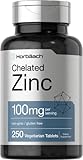
- 1. Horbäach Chelated Zinc Supplement 100mg — Best overall
- 2. Zinc Picolinate 50mg with Copper & Selenium — Best for heavy use
- 3. Bronson Zinc Glycinate 30 mg — Best for beginners
- 4. Pure Encapsulations UltraZin Zinc — Best compact
- 5. Pure Micronutrients Pure Zinc Supplement 25mg — Best premium
- Why the word "absorption" on the label proves nothing
- How long does one bottle actually last?
- What to check on the label before you buy
- The verdict
- FAQ
The best type of zinc for absorption, judged across these five listings, is a chelated form, and Horbäach Chelated Zinc Supplement 100mg is the pick I'd start with: 250 tablets in a 4.5 x 2.3 x 2.3 in bottle at the lowest price position of the five. If you'd rather take copper and selenium alongside it, the Zinc Picolinate 50mg with Copper & Selenium runs 240 capsules with 200mcg selenium and 2mg copper per serving.
Most shoppers compare milligrams. That is the wrong column. Every one of these five bottles clears the adult daily requirement several times over, so the number on the front is not what separates them. What separates them is the form the zinc is bound to, the size of the single daily dose, and how many days a bottle covers before you reorder.
Best type of zinc for absorption at a glance
| Pick | Zinc form | Dose & count | Price |
|---|---|---|---|
Best overall Horbäach Chelated Zinc Supplement 100mg |
Chelated zinc | 100mg 250 tablets |
Check Price |
Best for heavy use Zinc Picolinate 50mg with Copper & Selenium |
Zinc picolinate | 50mg 240 capsules |
Check Price |
Best for beginners Bronson Zinc Glycinate 30 mg |
Bisglycinate chelate | 30 mg 120 capsules |
Check Price |
Best compact Pure Encapsulations UltraZin Zinc |
Microencapsulated zinc | 90 capsules 1.2 x 3.2 x 1.3 in |
Check Price |
Best premium Pure Micronutrients Pure Zinc Supplement 25mg |
TRAACS bisglycinate chelate | 25mg (227% DV) 120 capsules |
Check Price |


How I screened these five zinc supplements
I started from the zinc listings in Amazon's Minerals category and read what each one publishes rather than what it promises. Three data points survived that filter: the chemical form named on the label, the milligrams per serving, and the capsule or tablet count.
The screen ran in this order:
- Form must be named. A listing that says only "zinc" tells you nothing about the search for the best type of zinc for absorption. All five here name a form: chelate, bisglycinate chelate, picolinate, or a microencapsulated delivery.
- Dose must be stated per serving. Four of the five publish a milligram figure. One, Pure Encapsulations UltraZin, leans on its technology description instead.
- Count must be published. These range from 90 capsules to 250 tablets, which is a spread wide enough to change the reorder rhythm entirely.
- Nothing bundled into a multivitamin. A B-complex with 8mg of zinc buried in it is a different product.
What got cut: unnamed "zinc complex" blends, anything where the form appeared only in marketing copy and not in the product title, and gummies, where the dose per piece varies with the serving size in ways the listing rarely makes clear. Five picks is a small field on purpose. Adding a sixth near-identical bisglycinate would have padded the table without giving you another real decision.
Chelate, picolinate or microencapsulated: what's the real difference?
Zinc is a mineral your body absorbs better when it's bound to something. A chelate is zinc attached to an amino acid or an organic acid, and that carrier is what changes how the mineral travels through your gut. This set gives you three distinct answers.
Bisglycinate chelate binds zinc to two glycine molecules. Two picks here use it. Pure Micronutrients names its raw material as TRAACS and calls it "the most bioavailable form that's gentle on your digestive system". Bronson names Albion Minerals as its supplier and claims "superior absorption, stability". Both are manufacturer claims, but the raw-material naming is unusual and worth something: it tells you which ingredient house made the powder.
Picolinate binds zinc to picolinic acid. The Zinc Picolinate 50mg pick is the only one here using it, and it's also the only one that adds 2mg copper and 200mcg selenium citrate per serving.
Microencapsulation is a different approach entirely. Pure Encapsulations UltraZin describes "a phospholipid bilayer around the" zinc, which is a delivery shell rather than a chelate bond. It's the only listing in the set doing this.
The Horbäach pick simply says "Chelated Zinc" without naming the specific amino acid. That's less information than the two bisglycinates give you. It also carries the largest dose and the largest count.
1. Horbäach Chelated Zinc Supplement 100mg — Best overall
A 250-tablet chelated bottle at the lowest price position here, which makes it the sensible default even though its form is described in general terms.
Best for: someone who wants a long-running chelated zinc bottle at the lowest position here Skip it if: you want a smaller per-capsule dose
Two figures put this one first. It holds 250 tablets, more than any other pick in this set, and it sits at the cheapest price position of the five. That combination is rare. The next-largest bottle here holds 240 capsules and sits a step higher in price.
The dose is 100mg per tablet, the highest in the group by a wide margin. That is a real consideration rather than a selling point. If you're taking zinc daily and long-term, a 100mg tablet is a lot more than a 25mg capsule, and the tablet form makes splitting awkward. Horbäach describes the product as "formulated for Superior Absorption" and lists it as naturally free of gluten, wheat, yeast, milk, lactose, soy and artificial colour, with a Non-GMO claim. Those are the manufacturer's words.
The bottle measures 4.5 x 2.3 x 2.3 in, and the model is listed as CL1913. Two sellers stock it.
Against the rest of the set, its weakness is precision. Where Bronson names Albion and Pure Micronutrients names TRAACS, Horbäach just says chelated. You're trusting the label rather than the raw-material brand.
Pros:
- 250 tablets, the largest count in this set
- Cheapest of the five picks
- Chelated form rather than plain oxide
- Free of gluten, wheat, milk, lactose and soy per the label
- Published bottle dimensions and model number
Cons:
- 100mg is the highest single dose here by a large gap
- Chelate type is not specified on the listing
- Tablets, so harder to halve than a capsule
- No stated warranty or guarantee period
2. Zinc Picolinate 50mg with Copper & Selenium — Best for heavy use
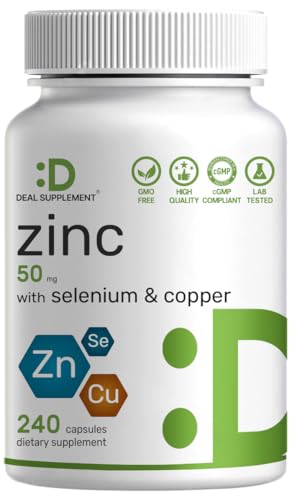
The only pick that bundles copper and selenium into the same capsule, across a 240-capsule bottle the listing calls an 8-month supply.
Best for: daily takers who want copper and selenium in the same capsule Skip it if: you already take a separate copper or selenium supplement
This is the one pick in the set that solves a problem the others ignore. Long-term zinc supplementation is usually discussed alongside copper, and this formula puts 2mg copper and 200mcg selenium citrate into each serving with the 50mg zinc picolinate. Nobody else here does that.
The count is 240 capsules, second-largest in this set, and the listing describes it as a one-a-day formula giving an 8-month supply. It sits at a mid price position, so you're paying more than Horbäach or Bronson but getting three minerals rather than one. The listing describes the blend as "a high bioavailable complex", and the quality claims cover Non-GMO ingredients, third-party lab testing, and manufacture in the USA without gluten, dairy, eggs, peanuts, soy, wheat or preservatives.
The published weight of 0.05 g is clearly a listing error rather than a real bottle weight, and no dimensions are given, so you can't judge the bottle size in advance.
The bundling cuts both ways. If your multivitamin already carries copper and selenium, this pick stacks them, and that's a conversation for whoever manages your supplements.
Pros:
- Only pick with copper and selenium in the same capsule
- 240 capsules, second-largest count here
- Named form: zinc picolinate at 50mg
- Third-party lab tested per the listing
- Mid price position rather than premium
Cons:
- Stacks copper and selenium you may already take
- 50mg zinc is high for indefinite daily use
- Published weight of 0.05 g is implausible
- No bottle dimensions listed
- No brand name given on the listing
3. Bronson Zinc Glycinate 30 mg — Best for beginners
A 30 mg bisglycinate in a vegetarian capsule, at the second-cheapest position here, which makes it the least intimidating way into the category.

Best for: a first-time zinc buyer who wants a moderate 30 mg vegetarian capsule Skip it if: you want the longest-lasting bottle in this set
If you've never taken zinc before and the 50mg and 100mg options look steep, this is the one to read first. Each vegetarian capsule delivers 30 mg as zinc bisglycinate chelate, which is the middle of this field, and the bottle holds 120 capsules. At the second-cheapest price position, it's the least committed purchase of the five.
Bronson names Albion Minerals as the chelate manufacturer, calling it "the premier manufacturer of chelated minerals" and claiming "superior absorption, stability". Naming the ingredient supplier is more information than most listings offer, and it's the same kind of detail the premium Pure Micronutrients pick provides. The listing adds laboratory testing, GMO-free, gluten-free and soy-free claims, cGMP manufacturing, and a company history going back to 1960.
What you give up is data. The listing publishes only the size and count. No dimensions, no bottle weight, no model number. Against the Horbäach pick, you get less than half the count for a higher price, and against Pure Micronutrients you get a plainer raw-material story at a lower one. It sits comfortably in the middle on almost every axis, which is exactly why it works as a starting point.
Pros:
- 30 mg is the most moderate dose among the cheaper picks
- Albion-sourced bisglycinate chelate named on the listing
- Vegetarian capsules
- Second-cheapest of the five
- GMO-free, gluten-free and soy-free per the label
Cons:
- 120 capsules, less than half the Horbäach count
- No dimensions or bottle weight published
- No model number listed
- Slowest-selling of the two entry-priced picks here
4. Pure Encapsulations UltraZin Zinc — Best compact
The smallest bottle in the set at 1.2 x 3.2 x 1.3 in, and the only pick using microencapsulation rather than a chelate bond.

Best for: anyone who wants the smallest bottle and a named delivery technology Skip it if: you refill infrequently or want the most capsules per bottle
Two things make this pick distinct. Its dimensions are 1.2 x 3.2 x 1.3 in, which is the smallest footprint here by a clear margin: the Horbäach bottle is 4.5 in tall and more than twice as wide. If shelf space or a travel bag is the constraint, this is the one that fits.
The second is the approach. Pure Encapsulations describes "an innovative microencapsulation technology" that "creates a phospholipid bilayer around the" zinc, aimed at enhancing absorption and bioavailability. Every other pick in this set uses a chelate or picolinate bond. This is a coating strategy instead, and it's the only example of it here. The listing also covers nutrient metabolism, energy production, tissue production and immune cell function, and the brand's free-from claims cover common allergens, artificial ingredients and GMOs.
The gaps matter. The listing does not publish a milligram figure per capsule, which is a strange omission in a category where dose is the first thing shoppers compare. Count is 90 capsules, the smallest in the set, and the price position is premium. That's the fewest capsules at close to the highest price, so it's the slowest-selling pick of the five for understandable reasons.
Pros:
- Smallest bottle at 1.2 x 3.2 x 1.3 in
- Only microencapsulated delivery in this set
- Free from common allergens and GMOs per the label
- Well-known practitioner brand
Cons:
- No zinc milligram figure published on the listing
- 90 capsules, the smallest count here
- Premium price position for the fewest capsules
- Slowest seller of the five
5. Pure Micronutrients Pure Zinc Supplement 25mg — Best premium
The lowest dose in the set at 25mg per capsule, built on named TRAACS bisglycinate chelate with a stripped-back ingredient list.

Best for: shoppers who want a named raw material and the lowest dose here Skip it if: price position matters more than the ingredient brand
This is the most conservative dose of the five: 25mg per capsule, which the listing puts at 227% DV. Compare that to 100mg from the Horbäach tablet and you can see how wide this field is. For long-run daily use, the smaller number is arguably the more sensible one.
The raw material is TRAACS bisglycinate chelate, named explicitly, and the listing calls it "the most bioavailable form that's gentle on your digestive system". The formula story is the tightest here: made without magnesium stearate, artificial flavours, preservatives or common allergens, and free from gluten, dairy, wheat, nuts, eggs and GMOs. The listing specifies a 20mm capsule, one per day, and a 120-day supply per bottle. Manufacturing is described as USA-based in cGMP and ISO17025 certified laboratories with third-party testing.
Two soft spots. The published weight of 5.5 lb for a 120-capsule bottle is not credible and should be read as a listing artefact. And at the highest price position with 120 capsules, you're paying the most per capsule in the set. Against Bronson's Albion-sourced 30 mg at a much lower position, the case rests almost entirely on the TRAACS name and the additive-free formula.
Pros:
- Lowest dose here at 25mg (227% DV)
- TRAACS bisglycinate chelate named explicitly
- No magnesium stearate or common allergens
- 20mm single-capsule daily dose
- cGMP and ISO17025 manufacturing claimed
Cons:
- Highest price position of the five
- 120 capsules, tied for second-smallest count
- Published 5.5 lb weight is implausible
- Costs more than Bronson for a similar chelate story
Why the word "absorption" on the label proves nothing
Four of these five listings use the word absorption or bioavailability in their bullets. Horbäach says "formulated for Superior Absorption". Bronson says "Chelated Superior Absorption". Pure Micronutrients says "maximizes absorption". Pure Encapsulations says its technology "enhance[s] the absorption and bioavailability of zinc".
That's marketing copy on every one. None of these listings publishes an absorption figure, a comparison study, or a percentage. So when you search for the best type of zinc for absorption, the label word cannot decide it for you, because every label uses it.
What you can compare is more mundane and more useful:
- Is the form named specifically? "Zinc bisglycinate chelate" and "zinc picolinate" tell you something. "Chelated zinc" tells you less.
- Is the raw-material supplier named? Bronson names Albion. Pure Micronutrients names TRAACS. That's a verifiable ingredient source rather than an adjective.
- Is there third-party testing claimed? Three of these five say so.
- Is the dose one you'd take indefinitely? 25mg and 100mg are not interchangeable, whatever the form.
Read the form and the dose. Treat the adjective as noise.
How long does one bottle actually last?
Count is the spec that quietly decides your reorder rhythm, and this set spreads wider than most:
- 250 tablets — Horbäach, the longest supply here
- 240 capsules — Zinc Picolinate, described as an 8-month supply at one a day
- 120 capsules — Bronson and Pure Micronutrients, roughly four months at one daily
- 90 capsules — Pure Encapsulations UltraZin, three months at one daily
At one per day, the gap between the top and bottom of that list is substantial. The Horbäach bottle runs nearly three times as long as the UltraZin bottle and sits at the cheapest price position, which is the single clearest value comparison in this whole set.
Two practical notes. First, a bigger bottle only helps if the dose suits you: 250 tablets of something you'd rather take every other day is a slower burn than the count suggests. Second, the smallest bottle has a real advantage that count hides. UltraZin's 1.2 x 3.2 x 1.3 in body is the one that travels, and the Horbäach bottle at 4.5 x 2.3 x 2.3 in is not.
What to check on the label before you buy
Use this on any zinc bottle, including ones outside this set:
- The form, spelled out. Bisglycinate, picolinate, gluconate, citrate, oxide. If the label only says "zinc", you don't know what you're getting.
- Milligrams of elemental zinc per serving. And the serving size. One capsule and two capsules per serving are different products at the same headline number.
- Whether copper is included. Only one pick here has it, and it changes how the product fits alongside anything else you take.
- Capsule versus tablet. Capsules in this set include vegetarian options from Bronson and a 20mm capsule from Pure Micronutrients. Tablets are harder to split.
- Additives named or excluded. Pure Micronutrients specifically excludes magnesium stearate, which is a level of detail most listings skip.
- Testing claims. Third-party or laboratory tested, stated on the listing rather than implied.
Anything a listing leaves blank is a question you'd be answering with a guess. That's the honest limit of what the best type of zinc for absorption research can settle from published data.
The verdict
The best type of zinc for absorption in this set is a chelated form, and Horbäach Chelated Zinc Supplement 100mg is the default I'd point most people to: 250 tablets, the cheapest position of the five, and a chelate rather than a plain oxide. On count-to-price alone it's not close.
Two conditions flip that. First, if you plan to take zinc daily for months, 100mg per tablet is more than you likely want, and the Bronson Zinc Glycinate 30 mg is the better shape of the same idea. It names Albion Minerals as the chelate source, uses a vegetarian capsule, and sits second-cheapest here with 120 capsules.
Second, if copper is part of your thinking, the Zinc Picolinate 50mg with Copper & Selenium is the only pick in this comparison that handles it, adding 2mg copper and 200mcg selenium citrate per serving across 240 capsules at a mid price position.
The runner-up's precise advantage over Horbäach is transparency. Bronson tells you which company made the chelate and which amino acid it's bound to. Horbäach tells you it's chelated and leaves it there. If that detail matters more to you than count, take Bronson and pay the small step up.
FAQ
What is the best type of zinc for absorption on a budget?
The best type of zinc for absorption on a budget, based on these five listings, is a chelated form from the cheapest position available. Horbäach's 250-tablet bottle sits at the lowest price position here and still uses a chelate rather than oxide. Bronson's 30 mg bisglycinate is the second-cheapest and names Albion Minerals as its chelate source.
Is a premium zinc supplement worth it?
A premium zinc supplement is worth it when the extra buys named information. Pure Micronutrients specifies TRAACS bisglycinate chelate, a 20mm capsule, no magnesium stearate, and ISO17025 laboratory manufacturing. That's more disclosure than the entry picks give. But it holds 120 capsules against Horbäach's 250, so you're paying more per capsule for detail rather than quantity.
How many milligrams of zinc do these picks contain?
The milligrams of zinc in these picks span a wide range: 25mg from Pure Micronutrients, 30 mg from Bronson, 50mg from the picolinate complex, and 100mg from Horbäach. Pure Encapsulations UltraZin does not publish a milligram figure on its listing. That four-fold spread means the form is only half the decision, and the dose is the other half.
Bronson Zinc Glycinate or Pure Micronutrients: which chelate should I pick?
Between Bronson Zinc Glycinate and Pure Micronutrients, both use bisglycinate chelate with a named supplier: Albion for Bronson, TRAACS for Pure Micronutrients. Both hold 120 capsules. Bronson gives 30 mg at the second-cheapest position here; Pure Micronutrients gives 25mg at the highest. Pick Bronson unless the additive-free formula and ISO17025 claims are worth the step up.
What mistake do zinc shoppers make most often?
The mistake zinc shoppers make most often is buying on the word "absorption" alone. Four of these five listings use it, so it separates nothing. It also leads people to the biggest milligram number, when 100mg per tablet may be far more than they want daily. Read the named form, the dose, and the count instead.
Pick a dose you'd be comfortable taking every day for months, then choose the largest count at that dose. That order matters, because a 250-tablet bottle of the wrong strength is a worse buy than a 90-capsule bottle of the right one. On that logic Horbäach Chelated Zinc Supplement 100mg wins on supply and price, Bronson wins on dose and ingredient transparency, and the picolinate complex wins if copper belongs in your routine. Check the current listing for whichever one matches your dose, and note the count before you add it.