Best Prenatal Vitamins for Eye Health Compared

Six prenatal vitamins compared on the nutrients that actually matter for a developing baby's eyes, with a clear winner and four scenarios that flip the pick.

By Harley GriffithsUpdated 15 min read
On this page
- Best prenatal vitamins for eye health at a glance
- The eye-health question, answered honestly
- How I screened this shortlist
- The nutrient that actually decides it
- 1. Nature Made Prenatal Vitamins with Folic Acid + DHA — Best overall
- 2. Thorne Basic Prenatal — Best upgrade
- 3. Pink Stork Total Prenatal + DHA — Most versatile
- 4. One A Day Prenatal Advanced — Best minimal setup
- 5. OLLY Prenatal Multivitamin Gummy — Best budget pick
- 6. Designs for Health Prenatal Pro — Best premium
- Which best prenatal vitamins for eye health suit which trimester?
- What more money actually buys
- Should you take a separate DHA supplement?
- The verdict
- FAQ
The best prenatal vitamins for eye health are Nature Made Prenatal with Folic Acid + DHA, because the 110-softgel bottle pairs 200 mg of DHA with folic acid in a single daily dose. If your stomach has fought back against standard iron, Thorne Basic Prenatal is the better call: 90 capsules built around iron picolinate, which Thorne says is non-constipating. Neither claims to fix eye conditions, and no prenatal on Amazon does. What they can do is cover the nutrients a developing baby's visual system draws on.
Best prenatal vitamins for eye health at a glance
| Pick | Count and dose | DHA source | Price |
|---|---|---|---|
Best overall Nature Made Prenatal + DHA |
110 softgels 1 daily |
200 mg fish-oil DHA | Check Price |
Best upgrade Thorne Basic Prenatal |
90 capsules 3 daily |
None included | Check Price |
Most versatile Pink Stork Total Prenatal + DHA |
60 capsules 2 daily |
200 mg vegan algae DHA | Check Price |
Best minimal setup One A Day Prenatal Advanced |
120 total (60+60) 1 softgel + 1 tablet |
DHA in softgel (amount not listed) | Check Price |
Best budget pick OLLY Prenatal Gummy |
60 gummies 2 daily |
None (gummy has no iron) | Check Price |
Best premium Designs for Health Prenatal Pro |
120 capsules methylated folate |
None included | Check Price |



The eye-health question, answered honestly
Amazon's search returned six broad prenatal multivitamins for the phrase "prenatal vitamins for eye health". None of the six is formulated specifically for vision, and only one product listing on the page mentions eye health at all. Nature Made says its formula supports "a baby's brain health, bone health, eye health, and nervous system development", which is a claim about developmental support, not a claim about improving eyesight.
That is the honest picture. If you came here hoping for a prenatal that fixes an eye condition, no product on Amazon does that, and any that claimed to would be lying. What a prenatal can do is deliver DHA, vitamin A, and the other nutrients that a growing baby's visual system draws on during pregnancy. That is why DHA content became the primary filter for this roundup, and it is why two picks that skip DHA still made the list on their other strengths.
How I screened this shortlist
Three reasons cut most listings before this six even formed.
- No DHA and no way to add it later without a second bottle. DHA is the omega-3 fatty acid most cited in prenatal listings as supporting a baby's brain and eye development. Products that skipped it and did not pair with a companion were dropped.
- No iron, when iron is what most pregnant buyers are looking for. Gummies without iron kept a place on this list only because that is a real preference for some buyers, not a mistake.
- Marketing-first listings with thin published specifications. Where a listing gave a proprietary blend and no per-nutrient figures, it was cut in favour of one that named its ingredients.
What survived is a mixed set on purpose: a fish-oil softgel, a vegan algae capsule, a two-pill combo, a gummy, and two practitioner-style capsule prenatals. Each covers a different buyer, and each has a specific weakness the others do not share.
The nutrient that actually decides it
Most guides to prenatal vitamins compare folic acid first. Folic acid matters, but every listing in this set covers it, so it does not separate them. The specification that actually splits this field is DHA: whether the product includes it, in what amount, and from what source.
Two picks state 200 mg of DHA on the label: Nature Made from fish oil, Pink Stork from algae. One A Day Prenatal Advanced includes DHA in its softgel but does not state the milligram figure in the listing. Thorne, Designs for Health, and OLLY leave DHA out entirely, which means you would pair them with a separate algae or fish-oil capsule.
The second deciding specification is the form of folate. Designs for Health names methylated folate and Thorne names L-5-methyltetrahydrofolate and folinic acid in a 1:1 ratio. The other four use folic acid. If a practitioner has told you to use methylated folate, that narrows this list to two picks straight away.
1. Nature Made Prenatal Vitamins with Folic Acid + DHA — Best overall
Nature Made wins because it puts 200 mg of DHA and folic acid into one softgel a day, and the 110-count bottle covers roughly three and a half months.
Best for: a first-time buyer who wants DHA and folic acid in one softgel Skip it if: you cannot swallow softgels or you avoid fish-sourced DHA
The core reason this pick leads is dose consolidation. Every other prenatal in this set either asks you to take two pills a day, take three, or add a separate DHA capsule. Nature Made asks for one softgel, and the 110-count bottle at that pace runs about 110 days. That is the longest single-bottle supply here without moving to the twin pack from One A Day. Nature Made says the formula supports a baby's brain, bone, eye, and nervous system development, and the label carries 200 mg of DHA plus all eight B vitamins including biotin. Nature Made also says the product is gluten free and contains no synthetic FD&C dyes. It is the second-cheapest of the six and sells faster than the rest of this set, which suggests it is a common default for shoppers who do not have a specialist requirement. The trade-off is fish-oil DHA rather than algae, and no methylated folate.
Pros:
- 200 mg of DHA in a single daily softgel
- 110-count bottle covers roughly 110 days at one a day
- Includes all eight B vitamins and biotin
- Gluten free per the listing
- Sells faster than the rest of this set
Cons:
- Fish-oil DHA, not algae
- Folic acid, not methylated folate
- Softgel format only, no chewable option
2. Thorne Basic Prenatal — Best upgrade
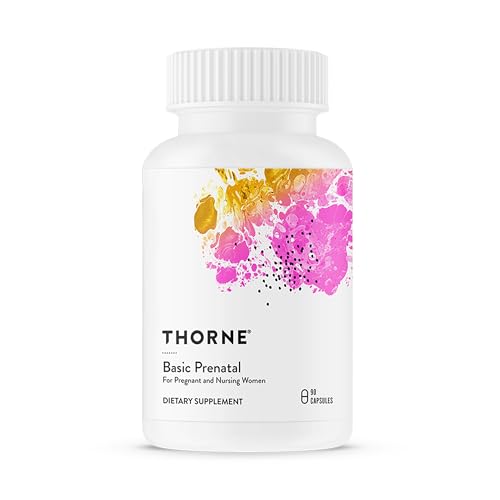
Thorne earns the upgrade slot because it uses iron picolinate and both active forms of folate, which Thorne says is easier on the stomach than standard formulas.
Best for: anyone who has struggled with iron-based stomach upset Skip it if: you want DHA included in the same capsule
Thorne is the practitioner pick here. The 90-capsule bottle is dosed at three capsules a day, which works out to a 30-day supply. What justifies the higher price position is the ingredient form: iron picolinate rather than a cheaper iron salt, and folate delivered as L-5-methyltetrahydrofolate and folinic acid in a balanced 1:1 ratio. Thorne says the well-absorbed, highly bioavailable nutrients reduce the risk of stomach upset, and that the iron picolinate is easy on the stomach and non-constipating. Constipation is one of the most common complaints with standard prenatals, so if that has been your experience, this is the pick that directly addresses it. The trade-off is that Thorne does not include DHA, so you would add a separate algae or fish-oil capsule. That pushes the real cost up and adds a second bottle to your morning. Thorne also sits at the second-highest price position of the six.
Pros:
- Iron picolinate, described as non-constipating
- Both active folate forms in a 1:1 ratio
- Practitioner-style capsule with named ingredients
- Three capsules a day allows split dosing
- 90 capsules per bottle
Cons:
- No DHA in the formula
- Three capsules a day, not one
- Higher price position than four of the six
3. Pink Stork Total Prenatal + DHA — Most versatile
Pink Stork is the pick for anyone who wants DHA without the fish-oil aftertaste, using vegan algae DHA in a berry-flavoured capsule.

Best for: vegans and anyone who dislikes fish-oil aftertaste Skip it if: you prefer a straightforward capsule with no flavour
This is the only pick in the set that delivers 200 mg of DHA from algae rather than fish. Pink Stork calls out fishy burps directly in the product name, which is the discomfort a lot of prenatal users report with softgel omega-3s. The bottle holds 60 capsules dosed at two a day, giving a 30-day supply. Pink Stork says the formula delivers 100% daily value of 14 OBGYN-recommended nutrients and is made without GMOs, gluten, soy, dairy, peanuts, tree nuts, or animal products. Pink Stork also says the product is third-party tested. Where this pick loses ground against Nature Made is bottle life, at one month rather than roughly three and a half, and price position, which sits mid-range for this set. The other trade-off is that this remains a folic acid formula, not methylated folate, so if a practitioner has asked for methylfolate you would still move to Designs for Health or Thorne.
Pros:
- 200 mg of vegan algae DHA
- No fish-oil aftertaste claim
- Fully vegan and free of major allergens
- Third-party tested per the listing
- 14 nutrients at 100% daily value per the brand
Cons:
- 30-day supply per bottle at two capsules daily
- Folic acid rather than methylated folate
- Berry flavour will not suit everyone
4. One A Day Prenatal Advanced — Best minimal setup
One A Day Advanced ships as a 60 softgel plus 60 tablet twin pack, splitting DHA and the multivitamin so you take one of each daily.

Best for: buyers who want a four-month supply in one purchase Skip it if: you dislike taking two separate pills each day
The pitch here is one softgel and one tablet each day, which gives you 60 days of coverage from the pack. One A Day calls out four brain-building essentials on the listing: choline, DHA, folic acid, and iron. Choline is worth flagging, because it is not universally present in prenatal listings and it is one of the nutrients most commonly named alongside DHA for a baby's neural development. One A Day says the pack is free of seven major US food allergens, including egg, dairy, wheat, peanut, and tree nut. The catch is that the listing does not name a milligram figure for DHA, which makes it harder to compare against Nature Made or Pink Stork on that specific criterion. The two-pill routine is also more setup than Nature Made's single softgel, and if you are trying to keep morning nausea to a minimum, one pill wins.
Pros:
- Includes choline, which most picks here do not name
- One softgel plus one tablet daily
- 120 pieces total in the twin pack
- Free of seven named allergens per the listing
- Sits in the middle of the price range
Cons:
- DHA milligram figure is not stated on the listing
- Two separate pills to remember
- Folic acid rather than methylated folate
5. OLLY Prenatal Multivitamin Gummy — Best budget pick
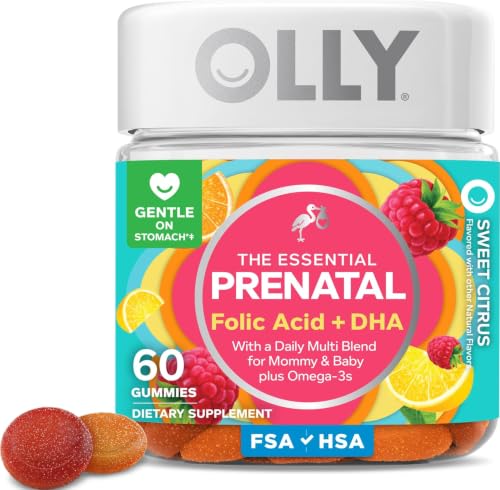
OLLY is the pick if you cannot keep a capsule down, delivering a raspberry-citrus gummy that needs no water and no food.
Best for: anyone who gags on capsules and wants a chewable Skip it if: you need iron in your prenatal
Morning sickness makes swallowing softgels genuinely difficult for some pregnant buyers, and that is where a gummy earns its place. OLLY holds the cheapest price position of the six and asks for two gummies daily, chewed thoroughly, with no water and no food required. The bottle holds 60 gummies for a 30-day supply. OLLY names folic acid, vitamin A, and vitamin D on the listing, and describes the flavour as a blend of raspberry and citrus. The trade-off is the one every prenatal gummy makes: iron does not sit well in a gummy format, so this formula does not include it. If your provider has flagged iron as a priority for you, this is not the pick. It is also a 30-day supply, so at two gummies a day the bottle turnover is faster than Nature Made or One A Day. Consider it a supporting player rather than a solo prenatal for many pregnancies.
Pros:
- Cheapest of the six
- No water or food needed to dose
- Raspberry and citrus flavour
- Vitamin D for immune support per the brand
- Chewable format for anyone who gags on capsules
Cons:
- No iron in the formula
- No DHA in the formula
- 30-day supply per bottle at two gummies daily
6. Designs for Health Prenatal Pro — Best premium
Designs for Health is the practitioner-tier pick, built around methylated folate and chelated non-constipating minerals across 120 capsules.

Best for: buyers with a practitioner recommending methylated folate Skip it if: you want a bottle that lasts more than a month at four capsules a day
This is the highest price position in the set and the slowest seller of the six, which usually signals a product bought on recommendation rather than by browsing. Designs for Health names methylated folate rather than folic acid, and calls out that many prenatals use synthetic folic acid instead. The brand says the minerals are chelated, including a non-constipating iron form, and that the formula suits preconception, pregnancy, and postnatal care across any trimester. The 120-capsule bottle sounds generous until you look at the dosing implied by a comprehensive methylated multi, which typically runs four capsules a day and gives 30 days per bottle. The listing does not include DHA, so you would still add an omega-3 alongside. What you are paying for is form quality and clean formulation, not extra ingredients over Thorne. If you are already committed to Thorne's approach, the two are close cousins with different formulation philosophies.
Pros:
- Methylated folate, not folic acid
- Chelated non-constipating iron form
- Suitable for preconception through postnatal per the brand
- 120 capsules per bottle
- Practitioner-style presentation
Cons:
- Highest price position of the six
- No DHA included
- Slowest seller of the set, indicating narrower appeal
Which best prenatal vitamins for eye health suit which trimester?
Prenatal needs shift across pregnancy, and the picks map to that shift more clearly than the listings admit.
- Preconception and first trimester: folate coverage is the priority. Designs for Health and Thorne both use active folate forms and are the strongest fit if a practitioner has flagged folate metabolism. Nature Made and Pink Stork use folic acid, which is what most public health guidance still names by default.
- Second trimester, when nausea often eases: this is where the DHA question becomes practical. Nature Made and Pink Stork put 200 mg of DHA in the daily dose. One A Day includes DHA without stating the amount. If you are on Thorne or Designs for Health, add an algae capsule now.
- Third trimester, when iron demand climbs: Thorne's iron picolinate and Designs for Health's chelated iron are the two picks that specifically address iron tolerance. OLLY has no iron at all, which becomes a bigger problem in the third trimester than the first.
- Postnatal and lactation: Pink Stork says its formula is designed for pregnant and lactating women, and Thorne describes its product as complete for pregnant and lactating women. Designs for Health also names postnatal care.
What more money actually buys
The cheapest pick here is OLLY, and the most expensive is Designs for Health. The gap between them is not linear, and it is not really about how many milligrams of anything you get.
At the entry position, you are paying for a working prenatal with folic acid, vitamin D, and either DHA or a gummy format. Nature Made and OLLY sit here. Nature Made adds DHA. OLLY drops iron for chewability.
In the middle, Pink Stork and One A Day add either vegan DHA sourcing or choline plus a two-pill routine. Neither is a large jump on ingredients, but the sourcing story is real: algae DHA and named allergen-free processing cost more to manufacture than fish-oil softgels.
At the premium end, Thorne and Designs for Health are paying for the form of the nutrient rather than the presence of it. Methylated folate, iron picolinate, chelated minerals: these are ingredient choices that a practitioner-facing brand can charge for and a mass-market brand cannot easily match without redesigning the whole formula. Neither of them includes DHA, which is worth knowing before you compare their sticker to Nature Made's on a per-bottle basis.
Should you take a separate DHA supplement?
Three of the six picks here include no DHA at all: Thorne, Designs for Health, and OLLY. If you buy any of those three, you are choosing to source your omega-3s elsewhere, and this is where the eye-health conversation returns. DHA is the nutrient most commonly named across these listings as supporting a baby's brain and eye development, so leaving it out entirely is not a neutral decision.
There is a case for pairing: a Thorne or Designs for Health formula with a separate algae DHA capsule gives you methylated folate, well-absorbed iron, and 200 mg or more of DHA, with the trade-off being two bottles and two morning routines. There is also a case against pairing: if the reason you like a prenatal is simplicity, adding a second capsule undoes that. Nature Made and Pink Stork are the two picks that avoid the question by putting DHA in the same bottle.
The verdict
Nature Made Prenatal with Folic Acid + DHA is the best prenatal vitamins for eye health choice for most first-time buyers, because it puts 200 mg of DHA and folic acid in a single daily softgel and stretches 110 softgels into roughly 110 days. That is the shortest daily routine, the longest single-bottle life, and the entry price position among picks that include DHA.
Thorne Basic Prenatal is the pick if standard iron formulas have upset your stomach, because Thorne says the iron picolinate is non-constipating and easy on the stomach. Pink Stork wins if you want vegan algae DHA in the same capsule and cannot stomach fish-oil burps. Designs for Health is the pick when a practitioner has specifically asked for methylated folate, and it justifies the highest price position with chelated mineral forms rather than extra ingredients.
None of these products treats eye conditions, and none is formulated specifically for vision. They are broad prenatal multivitamins that cover the nutrients a baby's developing visual system draws on. Choose on DHA, folate form, and iron tolerance, in that order.
FAQ
Do prenatal vitamins actually improve eye health?
Prenatal vitamins do not improve existing eye conditions in the mother, and Amazon listings that suggest otherwise are overstepping. What prenatals can do is deliver DHA, vitamin A, and other nutrients that support a baby's visual system development during pregnancy. Nature Made says its formula supports eye health development. That is a claim about supporting growth, not a claim about treating vision problems.
Is a prenatal with DHA worth the extra cost?
A prenatal with DHA is worth the extra cost if you would otherwise buy a separate omega-3 capsule, because you save one bottle and one daily pill. Nature Made and Pink Stork both include 200 mg of DHA in the same softgel or capsule as the multivitamin. If you already take a fish-oil supplement for other reasons, a DHA-free prenatal like Thorne can work well.
What is the difference between folic acid and methylated folate?
The difference between folic acid and methylated folate is the form the nutrient arrives in. Nature Made, OLLY, Pink Stork, and One A Day use folic acid, the synthetic form named in most public health guidance. Thorne uses L-5-methyltetrahydrofolate and folinic acid in a 1:1 ratio. Designs for Health uses methylfolate. Some practitioners recommend methylated forms for specific patients, so ask yours before choosing.
Nature Made or Thorne: which prenatal should I pick?
Nature Made or Thorne comes down to what you need in the bottle. Nature Made puts DHA and folic acid into one softgel a day for roughly 110 days. Thorne skips DHA, but delivers iron picolinate and both active folate forms across three capsules a day. Choose Nature Made for simplicity and included DHA. Choose Thorne for iron tolerance, active folate, and a practitioner-style formula.
What should I avoid when buying a prenatal vitamin?
Avoid prenatal vitamins that hide their ingredients behind a proprietary blend without per-nutrient figures, because you cannot compare what you are actually getting. Avoid gummy prenatals if your provider has flagged iron as a priority, because iron rarely sits well in gummy form. OLLY, for example, has no iron. Also avoid stacking a multivitamin with a separate iron pill without a provider's input, because too much iron causes problems.
Prenatal vitamin choices are personal, and the right pick depends on how your body handles iron, whether you can swallow softgels, and what your provider has said about folate. Nature Made is the sensible default because it removes the DHA question and stretches one softgel a day across roughly three and a half months. If that pick does not fit your situation, work backwards from the constraint that matters most: iron tolerance points to Thorne, vegan sourcing points to Pink Stork, methylated folate points to Designs for Health, and a swallowing problem points to OLLY. Talk to your provider before you commit, especially if you are already on another supplement.