Best Organic Iron Supplement for Women Who Cycle
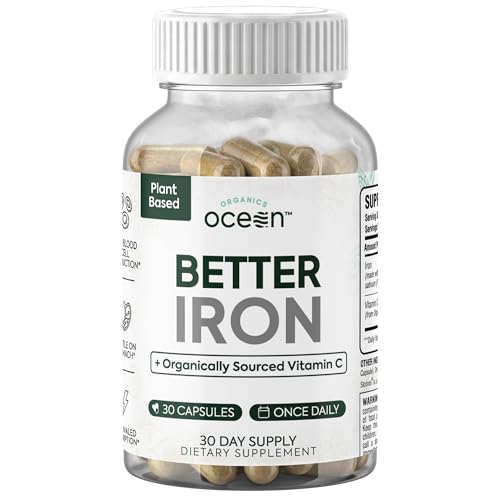
Six iron picks, one deciding question: how much elemental iron your body actually tolerates. Organics Ocean's 10 mg fermented-pea capsule takes the top spot, with five specific alternates for higher doses, liquid dosing, and tight budgets.

By Harley GriffithsUpdated 16 min read
On this page
- Best organic iron supplement for women at a glance
- How I screened the shortlist
- What counts as organic on an iron label?
- Dose, form, and the deciding trade-off
- 1. Organics Ocean Better Iron Supplement with Vitamin C — Best overall
- 2. MaryRuth's Liquid Iron Supplement — Best for families
- 3. Thorne Iron Bisglycinate — Best lightweight
- 4. Garden of Life Vitamin Code Raw Iron Supplement — Most versatile
- 5. Nature's Bounty Iron 65mg — Best budget pick
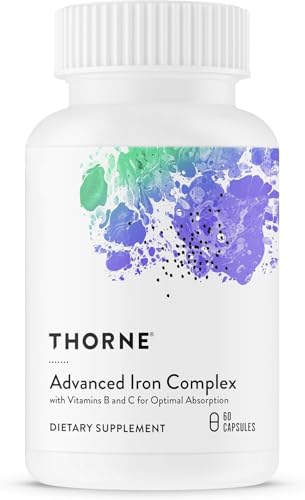
- 6. Thorne Advanced Iron Complex — Best upgrade
- Who should skip iron supplements entirely?
- What each price tier actually buys
- The verdict
- FAQ
The best organic iron supplement for women in this set is the Organics Ocean Better Iron capsule, a 10 mg fermented-pea formula the brand markets as vegan and non-GMO with no synthetic binders. For higher-dose repletion, Thorne Advanced Iron Complex is the better buy, pairing 36 mg of iron bisglycinate with B6, B12 and folate in a 60-capsule bottle. Getting iron wrong is not harmless. Too little and the fatigue you came to fix stays; too much and you trade it for nausea and constipation. That is why dose is the first thing to read on any label.
Best organic iron supplement for women at a glance
| Pick | Iron per serving | Form | Price |
|---|---|---|---|
Best overall Organics Ocean Better Iron |
10 mg claim | Fermented-pea capsule | Check Price |
Best for families MaryRuth's Liquid Iron |
Ferrochel claim | 15.22 fl oz liquid | Check Price |
Best lightweight Thorne Iron Bisglycinate |
25 mg claim | Bisglycinate capsule | Check Price |
Most versatile Garden of Life Vitamin Code Raw Iron |
22 mg claim | Whole-food capsule | Check Price |
Best budget pick Nature's Bounty Iron 65mg |
65 mg claim | Ferrous sulfate tablet | Check Price |
Best upgrade Thorne Advanced Iron Complex |
36 mg claim | Bisglycinate + B vitamins | Check Price |


How I screened the shortlist
Three criteria did the heavy lifting, in this order, and I picked the weights before I opened the listings.
- Iron form and dose disclosure. Any listing that hid the elemental iron figure or the chemical form was out. I wanted a number and a name on the label.
- A women's use case named in the copy. Every product on the shortlist speaks to menstruation, pregnancy, or repletion somewhere in its bullets.
- Certifications or process claims that back the label. Non-GMO, vegan, NSF Certified for Sport, or organic-ingredient sourcing all counted; a bare "quality" line did not.
Those three filters, together, cut a long category into six. I then ranked the survivors by how well each one matches a specific buyer, not by dose alone. A 65 mg tablet and a 10 mg capsule are not competing for the same reader, and pretending they are is how a roundup goes wrong.
One caveat worth stating up front: the search term is "organic iron supplement for women," and Amazon's results here are only partly on that brief. Two picks lead with organic sourcing language; the rest are clean-label, third-party-tested, or NSF-tested formulas that share shelf space with organic products. I have flagged which is which in every section below.
What counts as organic on an iron label?
Iron itself is a mineral, so it cannot be "organic" in the agricultural sense. What can be organic is the plant matter around it, the ferment used to bind it, or the food matrix a whole-food capsule is built on. That is the distinction to hold in your head while shopping.
- Organics Ocean Better Iron advertises organic pea ingredients and a fermented-pea source.
- Garden of Life Vitamin Code Raw Iron lists 23 powdered fruits and vegetables in its whole-food blend and carries Non-GMO Project verification and NSF Certified Gluten-Free.
- Thorne, MaryRuth's and Nature's Bounty do not lead with organic sourcing. Thorne's two entries lean on chelated bisglycinate and NSF Certified for Sport testing; MaryRuth's leads on vegan and Non-GMO; Nature's Bounty on 50 years of manufacturing history.
If certified-organic sourcing on the ingredient list is a hard requirement, your shortlist narrows to the first two. If clean-label with third-party testing is enough, all six are in play. Read the certifications on the listing rather than the word "organic" in a headline: they are the checkable part.
Dose, form, and the deciding trade-off
Most guides in this category compare brands. That is not what decides it. Dose and form do, and they are on every label if you look.
Elemental iron across this set runs from 10 mg to 65 mg per serving. That is more than a sixfold spread. It maps to two very different intents: daily maintenance at the low end, active repletion at the high end. The form matters almost as much as the number. Bisglycinate and ferrochel chelates are marketed as gentler on the stomach than ferrous sulfate, and Thorne calls its 25 mg capsule "non-constipating" for that reason. Ferrous sulfate at 65 mg, the Nature's Bounty dose, is the classic clinical starting point and also the classic complaint about stomach upset.
Here is the trick most shoppers miss: a lower dose you actually take every day beats a higher dose you abandon after a week. If a 65 mg tablet has ended a previous attempt at supplementing, a 10 mg or 25 mg chelate is not a compromise, it is the plan.
1. Organics Ocean Better Iron Supplement with Vitamin C — Best overall
A low-dose, fermented-pea capsule that reads as the closest thing to "organic iron" on this shortlist.
Best for: menstruating women who want a low, gentle daily dose Skip it if: your clinician has flagged low ferritin and asked for a higher dose
Organics Ocean is the most expensive pick here, and the only one whose iron source is described as fermented from organic pea ingredients rather than mined mineral salts. The brand lists 10 mg of elemental iron per capsule, once daily, and calls the dose "aligned with the body's natural absorption limits." Take that phrasing as the manufacturer's, because it is, but the underlying logic is sound: many women taking iron for maintenance do not need more.
The bottle is a 30-count, a month at one capsule a day. This is a 2026 release, which is worth knowing if you are the kind of shopper who watches supply chains: newer stock, smaller distribution footprint, and a listing that says only two sellers stock it. That last point is the honest weakness. Supply is thin compared with the Thorne and Nature's Bounty bottles that have been on the shelf for years, and the sales rank is the lowest of the six. If you need to reorder in a hurry, this is not the pick that guarantees it.
Pros:
- Fermented-pea iron sourced from organic pea ingredients
- Low 10 mg dose suits daily maintenance
- One capsule, once daily, no timing rules
- Vegan and non-GMO, no synthetic binders
- Newest formulation in the set
Cons:
- The most expensive pick here
- Only 30 capsules per bottle
- Limited seller coverage, harder to reorder quickly
- Dose too low for clinician-directed repletion
2. MaryRuth's Liquid Iron Supplement — Best for families
A 15.22 fl oz liquid iron formulated for ages 4 and up, so one bottle covers the household.

Best for: households sharing one bottle across ages 4 and up Skip it if: you dislike measuring liquids or want a travel-friendly capsule
This is the only liquid iron in the shortlist and the only one that names kids on the label. MaryRuth's uses ferrous bisglycinate chelate, branded Ferrochel, which the listing calls bioavailable and gentle. The bottle is 15.22 fl oz and weighs 1.12 lb, which sounds heavy because it is: this is a countertop product, not one to slip into a handbag.
The advantage over capsules is granular dosing. A parent can measure a child's serving down to a fraction of a teaspoon and give an adult a larger pour from the same bottle. The disadvantage is exactly the same feature: you have to measure it, every day, and iron has a metallic taste that no flavouring fully hides. It is also the second-most expensive here, and this is a specific price position within the set, not an implied dollar figure. As a family purchase spread across several users, it earns that position; bought for a single adult it does not.
Pros:
- Liquid dosing scales from ages 4 and up
- Ferrochel bisglycinate chelate, gentle-form claim
- 15.22 fl oz is a long-running family bottle
- Vegan, non-GMO, dairy free, gluten free, sugar free
- Sells faster than most of this set
Cons:
- Measuring every dose adds friction
- Heavy 1.12 lb bottle is not portable
- Iron taste is hard to mask in liquid
- No organic sourcing claim on the listing
3. Thorne Iron Bisglycinate — Best lightweight
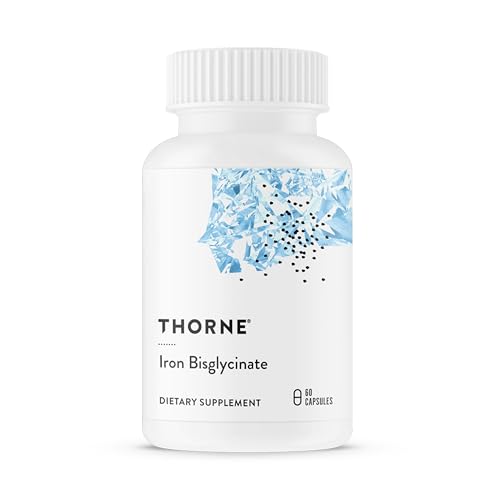
A 25 mg iron bisglycinate capsule from an NSF Certified for Sport line, in a 60-count bottle.
Best for: active women who want a mid-dose, sport-tested capsule Skip it if: you need B vitamins bundled with your iron
Thorne sits in the middle of this field on price and delivers 25 mg of elemental iron per capsule as bisglycinate. The listing describes the form as non-constipating and well-absorbed. The 60-count bottle is a two-month supply at once daily, and the whole package weighs 9.07 g on the specification sheet, which is a genuinely light bottle to carry in a training bag.
Two details push this to the "lightweight" award. First, the physical size, 3.72 by 2.09 by 2.09 in, is compact. Second, and more importantly for the audience, the bottle is NSF Certified for Sport, which Thorne describes as testing for the absence of nearly 300 substances banned by many major athletic organizations. If you compete, or you train around people who test, that certification matters more than any other line on the label.
The trade-off is what is not in the capsule: no B vitamins, no vitamin C, no folate, no cofactors. This is a single-ingredient chelate, which is a strength for anyone stacking their own regimen and a weakness for a shopper who wants one bottle that does several jobs.
Pros:
- 25 mg bisglycinate, non-constipating claim
- NSF Certified for Sport tested product
- 60-count bottle lasts two months at one a day
- Compact 3.72 x 2.09 x 2.09 in profile
- Sells faster than the rest of this set
Cons:
- No B vitamins or vitamin C paired in
- No organic sourcing claim
- Single active ingredient limits versatility
- Sits above budget picks on price
4. Garden of Life Vitamin Code Raw Iron Supplement — Most versatile
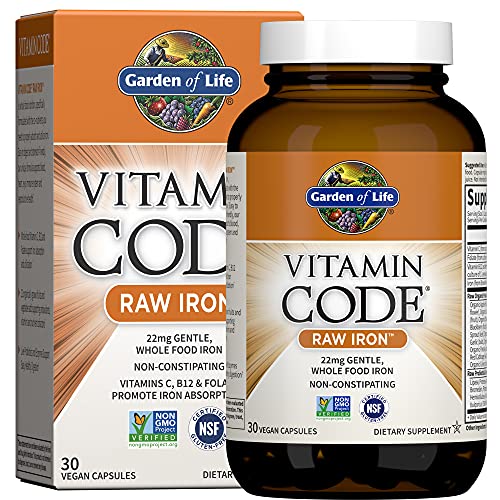
A 22 mg raw iron capsule built on a whole-food matrix of 23 powdered fruits and vegetables.
Best for: women who prefer whole-food formulas with built-in cofactors Skip it if: you want a certified organic ingredient list from front to back
Garden of Life is the second-cheapest of the six and the most feature-dense. One capsule provides 22 mg of raw iron with vitamin C, B12 and folate, plus 23 powdered organic fruits and vegetables, plus a probiotic and enzyme blend that the brand calls a RAW probiotic including L. bulgaricus, lipase and protease. That is a lot of ingredients in a 5.6 oz bottle.
The versatility argument is straightforward. If you take a multivitamin, a probiotic and an iron capsule already, this listing folds two and a half of those bottles into one. The Non-GMO Project verified and NSF Certified Gluten-Free stamps back the clean-label story. The listing also notes you can open the capsule and mix the contents with water or juice, which helps anyone who does not swallow capsules well.
Where it loses ground: "whole food" and "raw" are marketing language, not regulated terms in the way "USDA Organic" is. The 23 fruits and vegetables are described as organic, but the certifications called out on the listing itself are the non-GMO and gluten-free ones. If a full USDA-certified ingredient list is your bar, verify it on the label before you commit.
Pros:
- 22 mg iron with vitamin C, B12 and folate
- 23 powdered organic fruits and vegetables
- RAW probiotic and digestive enzyme blend
- Non-GMO Project verified, NSF gluten-free
- Capsule can be opened and mixed with juice
Cons:
- Long ingredient list not for minimalists
- "Raw" and "whole food" are unregulated terms
- 30-capsule bottle is a one-month supply
- Slower seller than most of this set
5. Nature's Bounty Iron 65mg — Best budget pick
A 65 mg ferrous sulfate tablet in a 100-count bottle, the classic high-dose format.

Best for: readers whose clinician recommended a standard ferrous sulfate dose Skip it if: ferrous sulfate has upset your stomach before
Nature's Bounty is the cheapest of the six and delivers 65 mg of elemental iron per tablet, from 325 mg of ferrous sulfate. That is the standard dose most clinicians reach for when someone is repleting an iron shortfall, and this is the standard chemical form. A 100-count bottle at one tablet a day runs more than three months, which is why the price-per-day maths on this pick is not close to the others.
The tablets have been on the market since 2012, which is a long track record and shows in the sales rank. That is the case for buying it: familiar dose, familiar chemistry, long shelf history. The case against it is what "ferrous sulfate" means in practice for many women. It is the form most associated with nausea and constipation, particularly at the 65 mg dose, and Nature's Bounty does not claim otherwise. If your last attempt at iron ended because of stomach upset, that history is the tell, not the price.
There is also nothing organic about this listing. It is a mineral-salt tablet in a green plastic bottle. It earns the budget award on dose per tablet, not on formulation.
Pros:
- The cheapest pick here by price position
- Standard 65 mg elemental iron dose
- 100-count bottle lasts over three months
- On the market since 2012, familiar chemistry
- Sells faster than the average of this set
Cons:
- Ferrous sulfate is the form most tied to stomach upset
- No organic or clean-label claim
- No paired vitamin C to aid absorption
- Tablet, not capsule, harder to split if needed
6. Thorne Advanced Iron Complex — Best upgrade
A 36 mg iron bisglycinate capsule paired with vitamin B6, methylcobalamin B12 and L-5-MTHF folate.
Best for: women repleting a documented iron shortfall over several months Skip it if: you already take a separate B-complex and want to avoid overlap
The second Thorne in the set steps up in two ways. Dose rises to 36 mg of elemental iron per capsule, still as bisglycinate, so gentleness of form is preserved. And the capsule adds three active B vitamins: B6 as pyridoxal 5'-phosphate, B12 as methylcobalamin, and folate as L-5-MTHF. Those forms are the biologically active versions rather than their cheaper precursors, which matters if you have ever been told you have an MTHFR variant.
Thorne describes four rounds of testing on every product, from raw-material purity to shelf-life confirmation. That process story is the reason this pick sits in the mid price band while claiming laboratory-grade positioning. Bottle size is 60 capsules at 1.4 oz total, a two-month supply once daily.
Two honest weaknesses. First, this listing sits in a Diet & Sports Nutrition category path rather than a straight Iron path, so search discovery is patchier and a shopper has to look for it by name. Second, if you already take a methylated B-complex, you are doubling up on the B12 and folate, which is not dangerous but is wasteful. The bisglycinate iron is the real upgrade; the B vitamins are the bonus.
Pros:
- 36 mg iron bisglycinate for active repletion
- Pyridoxal 5'-phosphate, methylcobalamin and L-5-MTHF
- Four rounds of testing described on the listing
- 60-count bottle, two-month supply
- Non-constipating chelate form claim
Cons:
- Overlaps with a methylated B-complex if you take one
- Sits in the mid price band, not entry
- No organic sourcing claim
- Category listing makes it harder to find by search
Who should skip iron supplements entirely?
Not every reader looking for the best organic iron supplement for women should be taking iron at all. This is the category's honest counsel.
- Post-menopausal women without a diagnosed deficiency. Iron demand drops when menstruation ends, and supplementing without cause is not neutral.
- Anyone who has not had ferritin or a full blood panel measured recently. Symptoms overlap with thyroid issues, B12 shortfalls, and simple sleep debt. Guessing wrong wastes months.
- Men without a diagnosed deficiency, at any age. The listings that name men do so because ferrochel and bisglycinate suit any adult; that does not mean every adult needs the pill.
- Anyone with hemochromatosis or a family history of it. Iron overload is real and it is not solved by "just a low dose."
If you are in any of those groups, ask for a ferritin test before you spend on any of the six. The right answer might be none of them.
What each price tier actually buys
The six picks sit across three price bands, and each band buys something different.
- Entry (Nature's Bounty, Garden of Life): a high-dose ferrous sulfate tablet or a whole-food raw capsule with cofactors. You pay less; you accept either the harshness of the classic form or the marketing looseness of "raw."
- Mid (Thorne Iron Bisglycinate, Thorne Advanced Iron Complex): chelated bisglycinate, non-constipating claim, third-party testing, and in one case NSF Certified for Sport. You pay more for form and lab process, not for a bigger dose.
- Premium (MaryRuth's, Organics Ocean): format innovation. Liquid dosing that scales across a family in one case; fermented-pea iron from organic pea ingredients in the other. You pay for what the pill physically is and how it is made.
None of the three tiers is objectively best. What decides is whether you value dose, form, or process, and in what order.
The verdict
If you are shopping the term "best organic iron supplement for women" and you want the pick that comes closest to it on this shortlist, buy the Organics Ocean Better Iron capsule. It is the only listing built on organic pea ingredients and the only one that treats fermented-pea iron as the headline claim rather than a footnote. The 10 mg dose suits daily maintenance for a menstruating adult, which is the largest group asking this question in the first place.
If your clinician has already told you your ferritin is low and asked you to replete, buy Thorne Advanced Iron Complex instead. The 36 mg bisglycinate dose does the work; the paired B6, methylcobalamin B12 and L-5-MTHF folate support the process; and the non-constipating claim gives you a shot at actually finishing the course. The cutoff is diagnosis. Below a documented deficiency, choose the gentler capsule and the lower dose. Above one, choose the higher dose and the B-vitamin stack. Buy neither if you have not tested your ferritin yet.
FAQ
Is an organic iron supplement worth it over ferrous sulfate?
An organic iron supplement is worth it if you have struggled with the stomach upset that ferrous sulfate tablets often cause, or if organic sourcing is a value you already apply to the rest of your pantry. Chelated forms like bisglycinate and ferrochel are marketed as gentler. If neither concern applies to you and a clinician has asked for 65 mg, the standard tablet still does its job.
What dose of iron do most women actually need?
Most women need iron in the range these six products span, from 10 mg for daily maintenance to around 65 mg for active repletion. Menstruation, pregnancy and blood donation raise the requirement. Post-menopause it drops. The listings covered here suit maintenance and mild repletion; higher clinical doses belong under supervision, not on an Amazon shortlist.
Organics Ocean Better Iron or Thorne Advanced Iron Complex?
Organics Ocean Better Iron and Thorne Advanced Iron Complex serve different jobs. Choose Organics Ocean if you want a 10 mg fermented-pea maintenance capsule with organic pea ingredients on the label. Choose Thorne Advanced Iron Complex if you want 36 mg of bisglycinate paired with active B vitamins for repletion. Dose and intent decide, not brand loyalty. Both are premium or mid-tier positions in this set.
Can I take a best organic iron supplement for women with vitamin C?
You can take a best organic iron supplement for women with vitamin C, and the pairing is common for a reason: vitamin C is widely reported to support iron absorption. Two picks here, Organics Ocean and Garden of Life, already include it in the capsule. If yours does not, a small glass of citrus juice with the dose is the simplest workaround, and it costs nothing.
What is the pitfall shoppers hit most often in this category?
The pitfall shoppers hit most often is buying the highest dose they can find, taking it for a week, and quitting when their stomach revolts. A 25 mg or 36 mg chelated capsule you finish beats a 65 mg tablet you abandon. Match dose to intent, and if you have not tested ferritin recently, do that before you spend on any organic iron supplement.
Your next step is small and specific: check whether you have had a ferritin reading in the last twelve months. If you have not, book that first and let the number decide the dose. If you have, and it points at maintenance, the Organics Ocean capsule is the closest thing on this shortlist to an actual organic iron supplement, at a dose the brand describes as aligned with daily absorption. The advantage of starting low with a chelated or fermented iron is that you get to keep taking it. Iron only works on the days it is in your body, and gentleness is what makes those days add up.