Best Extra Soft Anti Snoring Device by Fit Type

A category built around jaw-held mouthpieces, tongue retainers, chin straps and nasal dilators. Here is which one fits a sleeper who rolls between sides and back, and where each pick falls short.

By Harley GriffithsUpdated 16 min read
On this page
- Best extra soft anti snoring device for combination sleepers at a glance
- How I screened this shortlist
- Why 'extra soft' is not a spec you can compare
- 1. Reazeal Anti Snore Mouthpiece — Best overall
- 2. Snor Lock Anti Snoring Mouth Guard — Best premium
- 3. IFGZQU Tongue Stabilizing Device Mouthpiece — Most versatile
- 4. Snore Bastion Nasal Dilators for Sleeping — Best upgrade
- 5. RGIMF Anti Snoring Chin Strap for Sleeping & CPAP — Best for families
- 6. Urbesty Anti Snoring Tools for Men & Women — Best budget pick
- Which format suits a combination sleeper?
- What the listings do not tell you
- If you roll onto your back at 3am
- The verdict
- FAQ
The best extra soft anti snoring device for combination sleepers is the Reazeal Anti Snore Mouthpiece, an FDA-cleared jaw-supporting mouthpiece (model TD-03) that works the same way whether you sleep on your side or your back. If you want a firmer dual-tray fit with a stated 6 mm jaw-advancement design, the Snor Lock Anti Snoring Mouth Guard is the better buy. Combination sleepers roll several times a night, so the deciding factor is a device that keeps working through position changes, not one tuned to a single posture.
Best extra soft anti snoring device for combination sleepers at a glance
| Pick | Format | Key feature | Price |
|---|---|---|---|
Best overall Reazeal Anti Snore Mouthpiece |
Jaw-supporting mouthpiece | FDA cleared, model TD-03 | Check Price |
Best premium Snor Lock Anti Snoring Mouth Guard |
Dual-tray mouth guard | 6 mm jaw-alignment claim | Check Price |
Most versatile IFGZQU Tongue Stabilizing Device |
Tongue retainer | BPA-free silicone, travel case | Check Price |
Best upgrade Snore Bastion Nasal Dilators |
Nasal dilators | 4-pack, medium, silicone | Check Price |
Best for families RGIMF Anti Snoring Chin Strap |
Chin strap | Polyester knit, size M | Check Price |
Best budget pick Urbesty Anti Snoring Tools |
Oral device | Rinse-clean, light green | Check Price |




How I screened this shortlist
I started with the anti-snoring category on Amazon and applied three criteria in order. The first was that the pick address a specific mechanism of snoring, because "snoring" is not one problem. Jaw drop, tongue collapse and nasal restriction each need a different solution, and a shortlist that mixes them lets a reader match the format to their own cause. Six devices survived that filter, covering four distinct mechanisms.
The second criterion, which cut the largest number of listings, was clear evidence of the material or the mechanism in the product data. Listings that read only as marketing copy, with no specification, no format description, and no regulatory reference, were dropped. What remained were listings I could describe honestly using the manufacturer's own claims, attributed.
The third criterion was regulatory paperwork where the pick sits between the teeth. Two of the six mouthpieces here are stated as FDA cleared: the Reazeal (model TD-03) and the Snor Lock (K222475). That is not a guarantee of results, but a device that names its clearance is a device whose maker has taken the paperwork seriously, and that mattered for the top of the ranking.
Why 'extra soft' is not a spec you can compare
"Extra soft" is what the keyword asks for, and it is what the listings do not answer. None of the six specifies a Shore hardness, a durometer figure, or a comparative softness rating. The Urbesty listing calls its material "soft breathable"; the IFGZQU listing calls its silicone "soft BPA-free"; the Snore Bastion listing calls its dilators "incomparably soft" medical-grade silicone. Those are the manufacturers' own words, not standardised measurements, and they are not comparable across brands.
That matters because Amazon's own search ignored the extra-soft qualifier when it returned this set. Two of the six are hard-shell dual-tray mouthpieces where "soft" is not the promise at all. So this shortlist cannot honestly guarantee softness, and no pick below is claimed to. What it can do is separate the formats that tend to feel softer in the mouth (tongue retainer, nasal dilator, fabric chin strap) from the formats that do not (dual-tray boil-and-bite mouth guards).
If softness is your absolute priority, the silicone-based picks are where to start:
- IFGZQU Tongue Stabilizing Device, BPA-free silicone
- Snore Bastion Nasal Dilators, medical-grade silicone
- RGIMF Chin Strap, polyester knit rather than plastic
1. Reazeal Anti Snore Mouthpiece — Best overall
A jaw-supporting mouthpiece with FDA clearance and the fewest reasons to reject it for a sleeper who changes position.
Best for: combination sleepers who want a jaw-held device with a regulatory paper trail Skip it if: you cannot tolerate anything sitting between your teeth
Reazeal wins this shortlist on a narrow but honest margin. It is one of only two picks here whose listing names an FDA clearance, and it is the one buyers here choose more often than the Snor Lock. The mechanism is jaw support: the mouthpiece holds the lower jaw in position so the airway does not narrow when the muscles relax. That mechanism is agnostic to sleep position, which matters more than any single feature for a combination sleeper. A side-sleeping remedy that stops working when you turn onto your back is a remedy that stops working at 3am.
The listing is thin on figures. You get a colour (blue), a model number (TD-03), and a count of one. Reazeal describes the mouthpiece as designed for both men and women and easy to insert without adjustment. What it does not tell you is the material, the hardness, or the exact jaw-advancement figure. Against the Snor Lock, that is the trade Reazeal makes: less detail on the listing, and a slightly lower price position in this set.
Pros:
- FDA cleared, per the listing
- Jaw-support mechanism works across sleep positions
- Single-piece insert, no boil-and-bite step described
- The one buyers here reach for most
- Sits in the premium price band without topping it
Cons:
- No stated material or hardness
- No jaw-advancement figure given
- Only sold as a single count
- One seller currently lists it
2. Snor Lock Anti Snoring Mouth Guard — Best premium
A dual-tray mouth guard with a stated 6 mm jaw-alignment design and FDA clearance number K222475.

Best for: buyers who want a dual-tray fit and a stated jaw-advancement figure Skip it if: you dislike full upper-and-lower coverage in the mouth
Snor Lock is the most expensive pick here and the only one whose listing puts a number on the jaw geometry. The maker describes a 6 mm precision lower-jaw alignment, achieved by an integrated dual-tray structure that fits over the upper and lower teeth at once. It carries the K222475 FDA clearance for over-the-counter reduction of snoring in adults, and the listing states the device is made in Korea.
Where Reazeal is a single, simpler insert, Snor Lock is a two-tray structure that grips both jaws. That gives it a firmer, more stable feel and, for combination sleepers, a lower chance of shifting when you roll. It also makes it a larger presence in the mouth, which is the honest trade. Snor Lock does not describe itself as extra soft. It describes itself as durable and safety-tested, which is a different promise. The size is listed as a one-count pack, and one seller stocks it.
Against Reazeal, Snor Lock gives you the specific jaw-alignment figure and the dual-tray stability, at the highest price position in this set. If those matter to you, this is the upgrade. If they do not, you are paying for detail you will not feel.
Pros:
- 6 mm jaw-alignment design stated on the listing
- FDA clearance K222475 named
- Dual-tray structure covers upper and lower teeth
- Made in Korea, per the listing
- Fits all mouth sizes, per the maker
Cons:
- Highest price position in this set
- Larger presence in the mouth than a single-tray insert
- No stated material hardness
- Only one seller currently lists it
3. IFGZQU Tongue Stabilizing Device Mouthpiece — Most versatile
A soft-silicone tongue retainer that addresses a different mechanism than the two mouth guards above.
Best for: back-sleeping snorers whose tongue falls backward Skip it if: you breathe primarily through your mouth at night
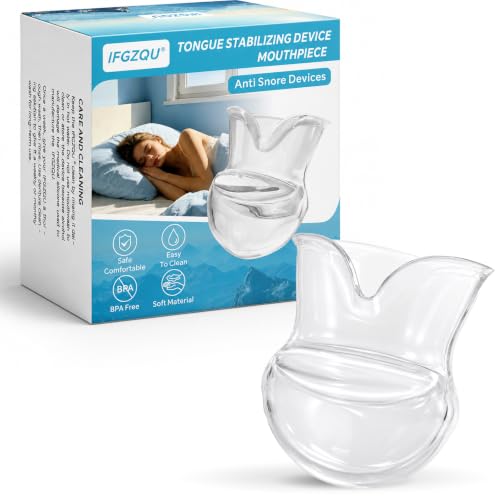
The IFGZQU works on the tongue, not the jaw. It has a small silicone chamber that holds the tongue forward by light suction, keeping it clear of the back of the throat. That is a real distinction from the two mouth guards: if your snoring is caused by tongue collapse rather than jaw drop, a jaw-held device will not fix it, and a tongue retainer will. The listing describes the material as BPA-free silicone and includes a travel case.
For a combination sleeper, the tongue retainer has one clear advantage and one honest limitation. The advantage is that tongue position matters most on the back, which is where snoring gets worst; a device that solves the back-sleep problem solves the loudest part of the night. The limitation is that a tongue retainer holds your tongue in a chamber, so it works best if you can breathe through your nose. Habitual mouth breathers find it harder to keep in place.
This is why the label is Most versatile rather than a runner-up: it is the pick that fits a specific problem the two mouth guards do not address. It sits in the mid price band here.
Pros:
- Targets tongue collapse, a distinct snoring mechanism
- Soft BPA-free silicone, per the listing
- Travel case included
- Mid-range price position in this set
- Rinse-clean design
Cons:
- Requires nose breathing to work well
- Suction takes practice to seat correctly
- No FDA clearance stated on the listing
- Limited specifications published
4. Snore Bastion Nasal Dilators for Sleeping — Best upgrade
A four-pack of soft silicone nasal cones for snorers whose problem starts in the nose, not the throat.

Best for: nose breathers who want nothing in the mouth Skip it if: your snoring is jaw-driven rather than nasal
Snore Bastion is the smallest, simplest and second-cheapest pick here. Four medium dilators in a pack, moulded from what the listing calls hypoallergenic medical-grade silicone. They sit inside the nostrils and hold the nasal passages slightly open, which raises airflow before it ever reaches the throat. That is a different problem from jaw drop or tongue collapse, and for the right sleeper it is the most comfortable answer, because nothing sits in the mouth at all.
For combination sleepers, this is the pick to consider when your partner reports that your snoring is quieter, breathier and more nasal than the deep back-of-throat sound. It also has a practical advantage that the mouthpieces do not: two sellers list it, so availability is less fragile, and the count of four means you can rotate them for hygiene.
The trade is that dilators do nothing for the two most common structural causes of snoring. If your jaw drops or your tongue falls back, the dilators will feel comfortable and the snoring will continue. This is a targeted upgrade, not a general answer, which is why it is number 4 rather than higher.
Pros:
- Four-pack, so rotation for hygiene is easy
- Medium size, listed as also available in S, L and XL
- Nothing sits in the mouth
- Two sellers currently list it
- Entry price band in this set
Cons:
- No effect on jaw-drop or tongue-collapse snoring
- Some sleepers find in-nose dilators dislodge in sleep
- No FDA clearance stated
- Single size per pack, so you must pick before buying
5. RGIMF Anti Snoring Chin Strap for Sleeping & CPAP — Best for families
A polyester-knit chin strap for keeping the mouth closed at night, usable with or without CPAP.

Best for: mouth breathers already on CPAP or wanting a fabric option Skip it if: you sleep hot or dislike anything wrapped around your head
The RGIMF chin strap is the only non-oral, non-nasal pick on the list. It is a fabric loop, size M, deep black, made of polyester knit. The mechanism is simple: it holds the lower jaw upward so the mouth stays closed, so air moves through the nose. The listing describes a four-sided structure intended to stay in place all night and an "advanced fabric of sports tights" for comfort.
This is the family-friendly pick for two reasons. First, it fits a wider range of buyers than any mouthpiece: no dental fitting, no boil-and-bite, no learning to seat a suction chamber. Second, it is CPAP-compatible per the listing, so a CPAP user whose mask leaks at the mouth can pair the two. That doubles the household it fits. It is the mid price band here.
For a combination sleeper the strap has a specific limitation worth naming. When you roll onto your side into the pillow, the strap edge can bunch. Some sleepers do not notice; others do. The listing does not name a size chart in centimetres, only an M designation, so pay attention to the sizing note before ordering.
Pros:
- Non-invasive, nothing in the mouth
- Stated as CPAP-compatible
- Fabric construction rather than plastic
- Four-sided structure claims all-night stability
- Mid-range price position
Cons:
- Only one size (M) stocked here
- Fabric can warm the face for hot sleepers
- Only tackles mouth-open snoring, not tongue or jaw drop
- The slowest-selling pick in this set
6. Urbesty Anti Snoring Tools for Men & Women — Best budget pick
The cheapest of the six and an easy first purchase for buyers unsure whether an oral device suits them.

Best for: first-time buyers testing whether an oral device suits them Skip it if: you want an FDA-cleared listing
Urbesty is the cheapest of the six and the one with the least published specification. The listing gives you a colour (light green), a model number (Urbesty-w001), and a set of manufacturer claims: soft breathable material, ergonomically crafted, cleaned by rinsing without disassembly. It is described as easy to use and safe. It is not described as FDA cleared, and it does not carry a jaw-advancement figure.
For a first-time buyer this is a rational entry point. If you have never worn any oral anti-snoring device before, spending the least on an ergonomic silicone-style insert lets you find out whether you can tolerate one at all before committing to a paperwork-heavy mouth guard. If it works, you know the format suits you and can move up. If it does not, you have learned something for a small outlay.
The honest trade is that Urbesty gives you less to check against. No clearance number, no material figures, no size chart. The slowest seller of the six except for the chin strap, and one seller lists it. It is number 6 for those reasons, not because the format is wrong.
Pros:
- Cheapest of the six
- Rinse-clean without disassembly, per the listing
- Ergonomic design claim from the maker
- Simple, one-piece format
- Comes in a distinct light-green colour
Cons:
- No FDA clearance stated
- Fewer published specifications than any other pick
- No jaw-advancement or material figures
- Only one seller currently listed
Which format suits a combination sleeper?
A combination sleeper is someone who changes position through the night, so the device has to keep working during and after each roll. That rules some formats in and rules others further down the list.
Jaw-supporting mouthpieces (Reazeal, Snor Lock) are the best structural match. Once the mouthpiece is seated, its effect does not depend on which way your head is facing. If your snoring is jaw-driven, this is the format to start with.
Tongue retainers (IFGZQU) work well on the back and the side but need light suction to stay seated. Rolling from stomach to back can loosen the seal, which some sleepers reseat in half-sleep and others do not. It is a strong format for sleepers who spend most of the night on their back or side.
Nasal dilators (Snore Bastion) are position-neutral. They keep working regardless of how you roll, but they only fix the nasal component of snoring. If yours is jaw or tongue driven, dilators alone are not enough.
Chin straps (RGIMF) work while you are on your back but can bunch against a pillow on your side. For combination sleepers this is the most position-sensitive format.
If you do not know which mechanism drives your snoring, the shortest path is to record a night on your phone, listen to the sound, and match it to the format. A wet, throaty rattle points at jaw drop. A dry buzz points at nose. Tongue collapse tends to sound like short, sharp closures rather than a steady snore.
What the listings do not tell you
The specifications published across these six listings are unusually thin. Here is what to check yourself before ordering, because none of it is in the data:
- Sizing. Only the chin strap and the nasal dilators quote a size. The mouthpieces do not describe a size chart, so if you have a small or large mouth, contact the seller before buying.
- Material hardness. No pick names a Shore hardness. If softness in the mouth is critical, silicone-based picks (IFGZQU, Snore Bastion) usually feel softer than dual-tray plastic guards.
- Warranty. None of the six lists a stated warranty length. Amazon's default return window is what you have.
- Fitting method. Boil-and-bite versus ready-to-wear is not clearly stated on every listing. Reazeal and Urbesty read as ready-to-wear; Snor Lock reads as a fitted dual-tray. Check the maker's instructions before your first night.
- Dental compatibility. No pick discusses use with dental implants, crowns, braces or dentures. If you have any of those, ask your dentist first.
- Cleaning cycle. Urbesty and IFGZQU describe rinsing; the others do not. Assume daily rinse and periodic deeper clean regardless of what the listing says.
If you roll onto your back at 3am
Snoring gets loudest on the back, because gravity pulls both the jaw and the tongue toward the airway. Combination sleepers who start on the side often end up on the back for part of the night without knowing it. That is the moment your device has to earn its place.
The Reazeal and the Snor Lock are the two picks least affected by that roll, because both hold the jaw in place mechanically. Between them, Reazeal is the simpler, cheaper answer and the one the sales data shows more buyers gravitate to. Snor Lock is the firmer, more detailed answer with a specific 6 mm advancement figure and named FDA clearance.
Two behavioural steps also help, and cost nothing:
- Sleep with a body pillow long enough to discourage a full back roll
- Raise the head of the bed by an inch or two
Neither is a substitute for the device, but both reduce how hard the device has to work at the worst moment of the night.
The verdict
If you are a combination sleeper looking for one device to buy first, the Reazeal Anti Snore Mouthpiece is the pick. Two reasons decide it: it works on jaw position, which is the mechanism least affected by rolling from side to back, and its listing carries an FDA clearance, which is the strongest piece of regulatory paper any pick here shows. It is priced in the premium band but not at the top, and it is the pick buyers here reach for most often.
Two conditions flip the recommendation. If you want a firmer dual-tray fit and a specified 6 mm jaw-advancement figure, the Snor Lock Anti Snoring Mouth Guard is the better choice, at the highest price position in this set. If your snoring is nasal rather than jaw-driven, or if you simply cannot tolerate anything in your mouth, the Snore Bastion Nasal Dilators are the sensible starting point and cost less than either mouthpiece.
The tongue retainer, the chin strap and the budget mouthpiece all have real roles for the right buyer, but none of them is the default answer for someone who does not yet know which mechanism drives their snoring. Start with jaw support, listen to what changes, and adjust from there.
FAQ
Is an extra soft anti snoring device actually softer than a standard one?
An extra soft anti snoring device is softer only if the listing gives you a figure to compare, and none of the six here does. "Soft" is the manufacturer's word, not a standardised measurement. Silicone-based picks like the IFGZQU tongue retainer and the Snore Bastion dilators tend to feel softer than dual-tray plastic guards, but neither publishes a hardness value you can rely on.
Is the Reazeal worth it over the cheaper Urbesty?
The Reazeal is worth it over the Urbesty if regulatory paperwork and mechanism clarity matter to you. Reazeal names an FDA clearance and describes itself as a jaw-supporting mouthpiece; Urbesty describes soft material and ergonomic design without naming clearance or mechanism. If you want the cheapest way to try the format first, Urbesty is fair. If you want the pick with more to check against, pay the difference.
Can combination sleepers use the RGIMF chin strap on their side?
Combination sleepers can use the RGIMF chin strap on their side, but with a caveat. The strap edge sometimes bunches against a pillow when you turn, which some sleepers reseat in half-sleep and others notice as pressure. The listing describes a four-sided structure intended to stay in place all night. If you sleep on your back for most of the night, the strap fits better than for sleepers who spend most of the night side-down.
Reazeal vs Snor Lock: which is the better mouthpiece?
Reazeal vs Snor Lock comes down to detail versus simplicity. Both carry FDA clearance on the listing. Reazeal is a simpler single-piece insert at a lower price position and is the one buyers here choose more often. Snor Lock is a dual-tray design with a stated 6 mm jaw-advancement figure and the highest price position in this set. Choose Snor Lock if the figure and firmer fit matter; choose Reazeal otherwise.
What is the most common mistake buyers make in this category?
The most common mistake buyers make in this category is choosing the format before identifying the mechanism. Snoring caused by jaw drop, tongue collapse and nasal restriction each need a different device. A nasal dilator will not stop jaw-driven snoring, and a jaw mouthpiece will not stop nasal-driven snoring. Record a night on your phone and match the sound to the mechanism before you pick the format.
Whichever pick you start with, give it seven nights before deciding whether it works. Oral devices in particular need a few nights for the jaw and tongue to settle. Watch for two things: whether your partner reports quieter nights, and whether you wake more rested. If both improve, you have the right format. If only one improves, the device is working on part of the problem, and a second format may pair with it, such as nasal dilators alongside a mouthpiece. If neither improves after a week, the mechanism driving your snoring is likely different from what the device targets, and it is time to try another format from this list rather than a second product in the same one.